
The Kitchen in Pickleball: Non-Volley Zone Rules Explained
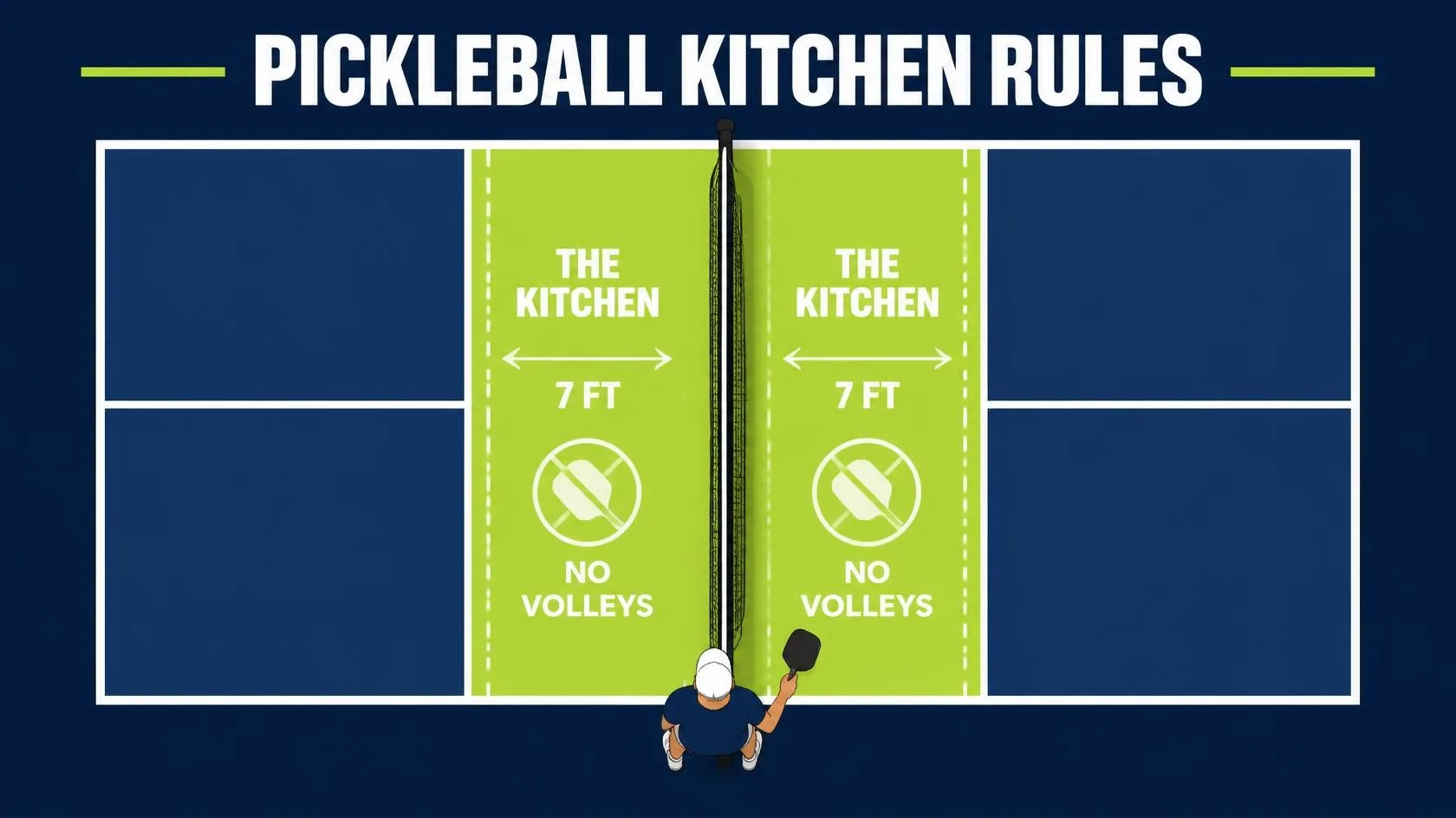
Pickleball kitchen rules in one sentence: you cannot hit a volley while you, or anything connected to you, is touching the kitchen.
Ask ten beginners what confuses them most and nine will point at the striped patch of court in front of the net. The kitchen looks like a trap. Players tiptoe around it, argue about it, and lose points in it that they never saw coming.
Learn that sentence, then learn the two twists that come with it (momentum counts, and both feet have to get back out), and you understand the whole zone.
Pickleball kitchen rules at a glance
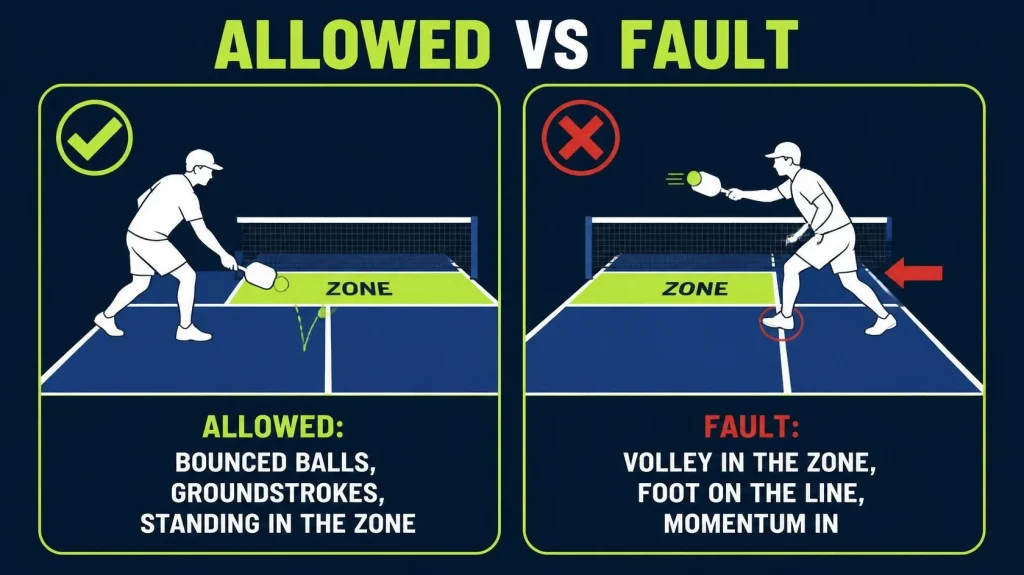
| Situation | Legal or fault? |
|---|---|
| Standing in the kitchen between rallies | Legal |
| Stepping in to hit a ball after it bounces | Legal |
| Staying in the kitchen after hitting a bounced ball | Legal |
| Volleying with a foot on the kitchen line | Fault |
| Volleying clean, then your momentum carries you in | Fault |
| Reaching your paddle over the kitchen to volley, feet outside | Legal |
| A serve landing in the kitchen or on its line | Fault |
| Your partner standing in the kitchen while you volley | Legal |
What is the kitchen, and why does it exist?
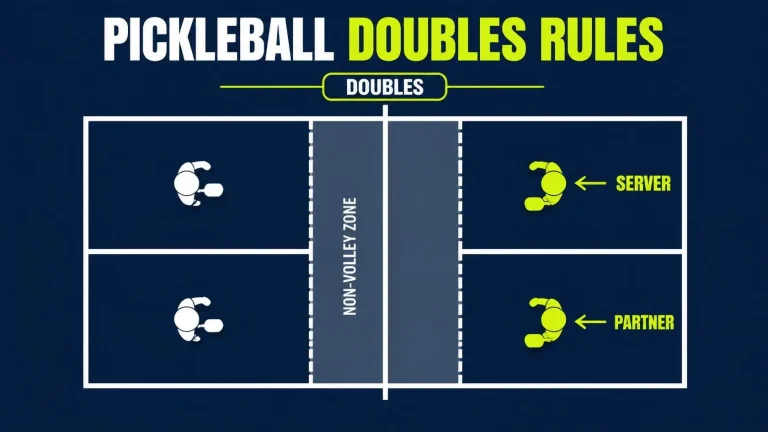
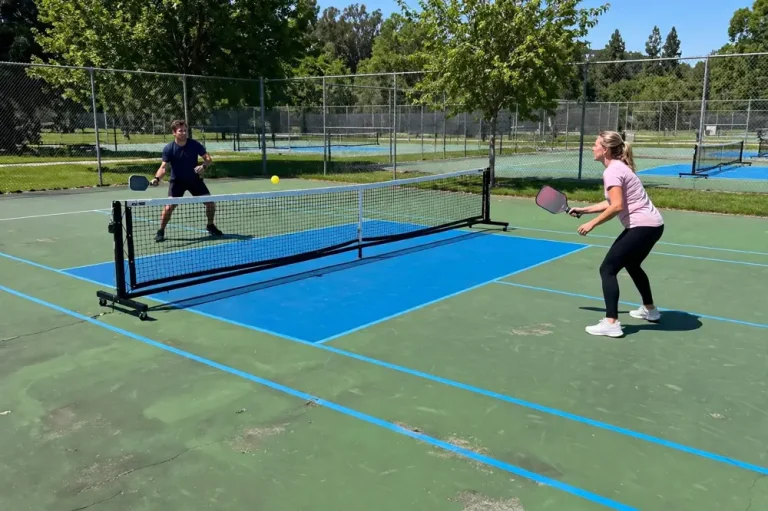
In pickleball kitchen rules, the kitchen is the non-volley zone, or NVZ. It is the area within 7 feet of the net on both sides, stretching the full 20-foot width of the court between the sidelines. The line at the back of it is called the NVZ line, and the line itself is part of the zone. Step on the line and you are in the kitchen, rules-wise. You can see exactly where it sits in our guide to pickleball court dimensions.
Why does pickleball have this odd patch of court? Picture the game without it. The tallest, strongest player would park a foot from the net and smash every ball straight down. Rallies would last two shots. The kitchen pushes everyone back 7 feet, which takes the cheap smash away and replaces it with patience, soft hands, and placement. It is a big reason pickleball rewards touch as much as power, and it keeps bodies from colliding at the net.
The core pickleball kitchen rule: no volleys while touching the kitchen
A volley is any shot you hit out of the air before the ball bounces. Rule 11.A of the USA Pickleball rulebook says all volleys must be initiated outside the non-volley zone. Touch the zone or its line at any point during your volley and it is a fault, rally over.
Two details trip people up here.
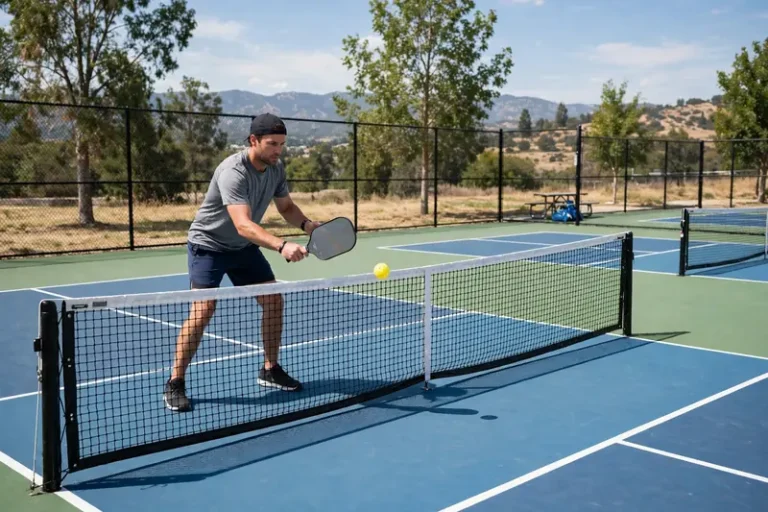
- First, the kitchen is the ground, not the air above it. Your paddle, your arm, even your whole upper body can cross over the kitchen while you volley. Nothing breaks a rule until something actually touches the surface of the zone. Reach in all you want. Just do not land anything in there.
- Second, “you” includes everything attached to you. Rule 11.A.1 covers the volleying player plus anything in contact with that player during the shot. Your paddle counts. So does your hat, your shirt, and a ball tucked in your pocket. If your paddle tip brushes the court inside the zone during your swing, before or after you strike the ball, that is a fault under Rule 11.A.1.
In short: So the plain version: feet out, body balanced, nothing touching the zone or the line, and you can volley as hard as you like.
The momentum rule: the fault that happens after the shot
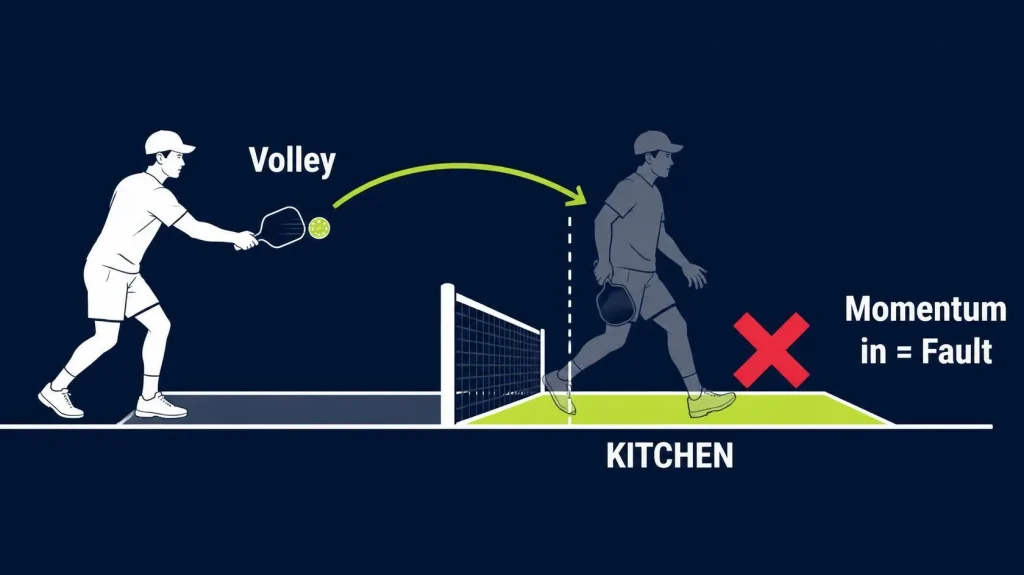
This is the rule that starts arguments. The rulebook’s definition of Momentum says the act of volleying produces momentum that ends when the player regains balance and control, or stops moving toward the non-volley zone. Your volley is not finished when the ball leaves your paddle. It is finished when your body is back under control.
That gives us Rule 11.A.2, the momentum rule. If your momentum from a volley causes you to touch the kitchen, or to touch anything that is touching the kitchen, it is a fault. Three scenarios show how it plays out.
- The smash that costs the point. You back up, crush an overhead out of the air, and your swing carries you forward onto the line. The ball bounces twice before your opponent moves. Does not matter. Rule 11.A.2 says it is a fault even if the ball became dead before you touched the zone. A winner buys you nothing if your feet betray you afterward.
- The partner bump. Your partner is standing in the kitchen, which is legal on its own. You volley from outside, lose your balance, and stagger into your partner. Because your momentum made you contact something touching the zone, that is your fault. Your partner did nothing wrong. You did.
- The dropped hat. Mid-volley, your cap falls into the kitchen. Fault. It was part of you during the act of volleying, and the act of volleying put it there.
Notice what the momentum rule does not touch: shots played off the bounce. If the ball bounces in the kitchen and you step in and hit a groundstroke, you can stay right where you are. The volley restriction never applied, so there is nothing to police.
✓ Pro tip: The habit that keeps you safe is simple. Hit the volley, then stop your feet before you admire the shot. Small steps and a balanced finish beat a big lunge.
Stepped in for a dink? Both feet back out before you volley
Rule 11.A.3 handles the reset in pickleball kitchen rules. If you have touched the non-volley zone for any reason, you cannot volley again until both of your feet have touched the playing surface completely outside the zone. Both feet. Fully outside. Not one foot, not mostly out.
The sneaky version of this fault is the jump-out. You are standing in the kitchen after playing a dink, the next ball sits up, and you leap out and volley it in mid-air, landing behind the line. The rulebook names this exact move as prohibited: your volley started from inside the zone, and where you land does not fix where you started.
The push-off trap catches people too. Pushing off the line with one foot to stretch for a volley still counts as touching the zone. Wait until both feet are planted clear, then swing.
Edge cases you will actually argue about
Use this table to check pickleball kitchen rules in edge cases.
| What happened | Call | Why |
|---|---|---|
| The ball bounces in the kitchen and you step in and hit it | Legal | Bounced balls can be played from anywhere |
| You reach over the kitchen and volley with your feet planted outside | Legal | The zone is ground, not airspace |
| Your paddle crosses the line in the air during a volley | Legal | Nothing touched the zone |
| Your paddle tip brushes the court inside the zone during your swing | Fault | Rule 11.A.1, the paddle counts as part of you |
| You volley clean, then momentum steps you onto the line | Fault | Rule 11.A.2, momentum is part of the volley |
| Your momentum bumps your partner, who is standing in the kitchen | Fault | Rule 11.A.2, contact with anything touching the zone |
| You jump out of the kitchen, volley mid-air, and land outside | Fault | Rule 11.A.3, the volley started inside the zone |
| Your hat falls into the kitchen as you volley | Fault | Anything you wear or carry counts during a volley |
| You jump around the net post and land wide of the kitchen (an Erne) | Legal | Takeoff and landing both stayed outside the zone |
| A serve clips the kitchen line | Fault | Serves have to clear the zone and its line |
What you CAN do in the kitchen
New players often treat the kitchen like lava, and that fear costs them points. Under pickleball kitchen rules, the zone only restricts volleys. Everything else is fair game.
You can step in to play any ball that has bounced, including a short dink that barely clears the net. You can stay in afterward, for the rest of the rally if you like. You can stand in it between rallies, walk through it to chase a lob, and reach into it for a ball that bounced at your feet. Your partner can stand in it while you volley, as long as you do not touch each other during your shot.
And the ball itself can land in the kitchen all day. The kitchen restricts players and serves, never the ball during a rally.
The serve has its own kitchen rule
Under pickleball kitchen rules, the serve is the one shot that cannot touch the kitchen at all. A legal serve must clear the non-volley zone and its line and land in the correct diagonal service court. A serve landing in the kitchen is short, and one that clips the NVZ line is a fault too. That line is the odd one out on the court: every other line counts as in, but on a serve the kitchen line counts as out. Our pickleball serve rules guide covers the rest of the serving rules, including what changed in recent rulebooks.
Common kitchen faults beginners make
These common faults show pickleball kitchen rules in action.
- Toeing the line on a volley. Your shoe brushes the NVZ line as you stretch forward. The line is part of the zone, so the brush is a fault.
- Smashing and falling in. The overhead goes down clean, then your momentum takes two steps into the kitchen. Textbook momentum fault.
- Jumping out to volley. You played a dink from inside, then sprang out and volleyed before both feet touched down outside. Rule 11.A.3 says no.
- The paddle dip. On a low volley, your follow-through drops and the paddle tip taps the court inside the zone. Fault under 11.A.1, and nobody saw it but your opponent.
- Forgetting to reset after a dink. You step in for a bounced ball, stay planted, and volley the next one from inside. Both feet have to get back out before that volley counts.
- Never entering at all. Not a fault, but a costly mistake. Players who refuse to step in give up every short ball and play the whole game on their heels.
Drills that teach your feet the rules
These drills teach pickleball kitchen rules through footwork.
- Dink and freeze. Rally cross-court dinks with a partner. After every shot, freeze for a second and look down: in, out, or on the line? The habit of always knowing where your feet are is the whole point.
- Feed and hold. Have a partner feed balls from across the net while you stand just behind the line and volley each one. After contact, hold your finish position for two seconds. If you cannot hold it, momentum would have carried you in during a real rally.
- In and out. Your partner alternates feeds: one short ball that bounces in the kitchen, then one higher ball you can volley. Step in for the first, get both feet fully back out, then volley the second. That is the 11.A.3 reset, drilled until it is automatic.
- Line dance dinks. Play a cooperative dink game at the line, keeping the ball low and soft. Volley from a toe on the line, or let momentum drag you in, and you lose the mini-rally. Short sessions fix footwork faster than lectures.
Kitchen strategy basics: dinks, resets, and patience
Good kitchen play looks boring from the fence. That is the point. The soft game wins because it gives your opponent nothing to attack. The same soft game applies on a dedicated court or on a converted tennis court.
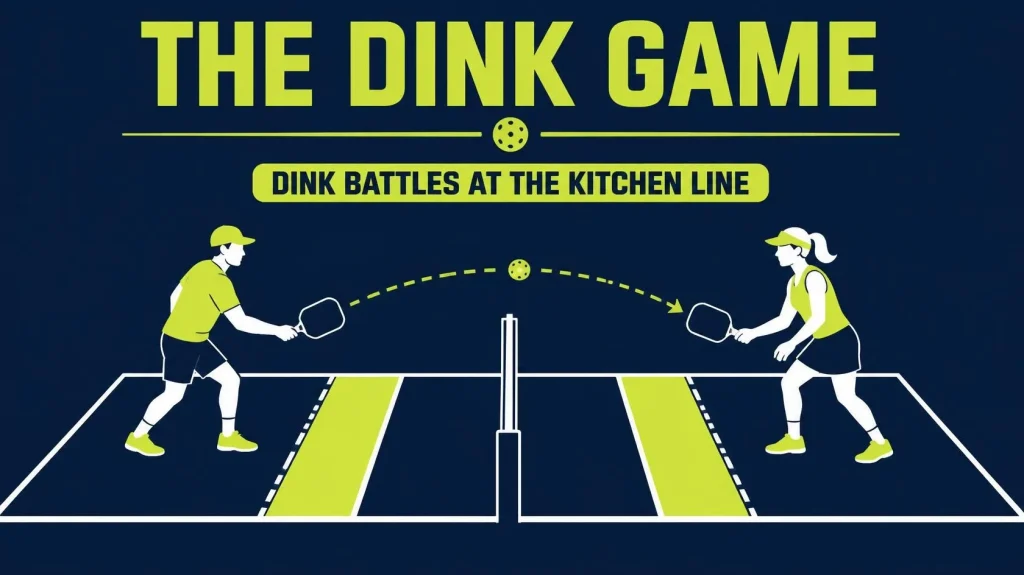
- Dink battles. A dink is a soft, arcing shot that lands in the other kitchen and stays low. When all four players are at the line, rallies become a contest of patience. Keep your dinks low and unattackable, move them around a little, and wait. Sooner or later somebody pops one up, and that pop-up is your volley. The player who gets impatient first usually loses the exchange.
- Resets. When you are stuck in the middle of the court and a hard ball comes at your feet, do not swing big. Block it softly so it drops into the kitchen. That shot is called a reset. It slows the rally, takes the attack away, and buys you time to get back to the line.
- Footwork at the line. The best spot in pickleball is right behind the NVZ line, close enough to reach a dink without stepping in, far enough back to volley legally. Stay on the balls of your feet, take small steps, and split-step as your opponent swings. Most kitchen faults are really footwork faults that happened two shots earlier.
So why is it called the kitchen?
Honestly? Nobody knows for certain. The rulebook has only ever called it the non-volley zone, and no official document records who first said “kitchen”. Anyone who gives you a single confident answer is guessing.
The account you will hear most often comes from shuffleboard. In deck shuffleboard, the penalty area behind the scoring zones, the “10-off” area, was nicknamed the kitchen, and players warned each other not to get caught in it. Pickleball grew out of backyard games in the 1960s and borrowed plenty of language from other rec sports, so the name plausibly rode along.
The other popular account is the old saying: if you cannot stand the heat, stay out of the kitchen. It fits a zone where the action gets hot and a small mistake gets punished. Both stories get repeated because they feel right, not because either is proven. What is certain is that the nickname stuck and the rulebook kept the formal name.
What the current rulebook says, in short
Pickleball kitchen rules live in Section 11 of the USA Pickleball Official Rulebook. The 2026 edition restructured the numbering and moved the definition of the act of volleying in with the other definitions, but the way the zone plays has not changed. These rules apply the same way in singles and doubles.
Two small notes worth knowing. In a game without a referee, either team can call a non-volley zone fault, so call your own honestly, and if the two teams genuinely disagree about a foot fault, the rally is replayed. And for wheelchair players, the front, smaller wheels are allowed to touch the zone during a volley, while the rear wheels follow the same both-wheels-out reset as everyone else’s feet.
Pickleball kitchen rules FAQs
Can you step in the kitchen in pickleball?
Yes, any time you like, as long as you are not volleying. Stepping in to play a bounced ball is not just legal, it is necessary. The only forbidden move is hitting the ball out of the air while touching the zone or its line.
What is a kitchen fault?
A kitchen fault is any non-volley zone violation during a volley: touching the zone or line while volleying, momentum carrying you in afterward, your paddle or anything you wear touching the zone during the shot, or volleying before both feet are re-established outside. A fault ends the rally.
Can you serve into the kitchen?
No. The serve must clear the non-volley zone completely, line included, and land in the correct diagonal service court. A serve that lands in the kitchen or touches the NVZ line is a fault. After the serve, though, any shot can land in the kitchen, including the return.
Does the momentum rule apply after the ball bounces?
No. The momentum rule only applies to volleys, because it comes from the definition of the act of volleying. Once the ball bounces, you are playing a groundstroke. You can step in, hit it, and stay in the kitchen afterward, no momentum concerns.
Can your paddle cross the kitchen line during a volley?
Yes. The kitchen is the court surface, not the air above it. Your paddle and body can cross the line and reach over the zone, as long as nothing actually touches the zone. Touching the surface is the fault, not crossing the plane.
Can you stand in the kitchen while your partner volleys?
Yes. Your partner’s position has no effect on your volley. It only becomes a fault if your volleying motion or momentum makes contact with your partner while they are touching the zone. Contact connects your volley to the zone.
What if you jump from inside the kitchen and land outside?
Still a fault, if you volleyed on the way. Rule 11.A.3 requires both feet to touch the surface completely outside the zone before you volley again after being in it. The volley started from inside, and landing outside does not rescue it.
What happens if your hat or paddle falls into the kitchen after a volley?
That is a fault. Anything you are wearing or carrying is treated as part of you during the act of volleying. If your volley or its momentum sends your hat, paddle, or anything else into the zone, the rally is over. Tighten the hat, mind the follow-through.
Why is it called the kitchen?
Nobody documented it. The most repeated account traces the nickname to shuffleboard, where a penalty area was called the kitchen, and the saying about standing the heat is the other popular explanation. The rulebook itself only ever says non-volley zone.
Can you hit a ball that bounces in the kitchen without stepping in?
Yes, and you often should. A low dink can be reached from behind the line by leaning in with your paddle while your feet stay out. Reaching is free. If the next ball pops up, your feet are already legal for the volley, which is the whole advantage of staying out.
Checked: October 25, 2026, against the USA Pickleball Official Rulebook 2026 edition (Section 11 and definitions).
7 Comments