Pickleball Serve Rules: What Is Legal and What Is Not
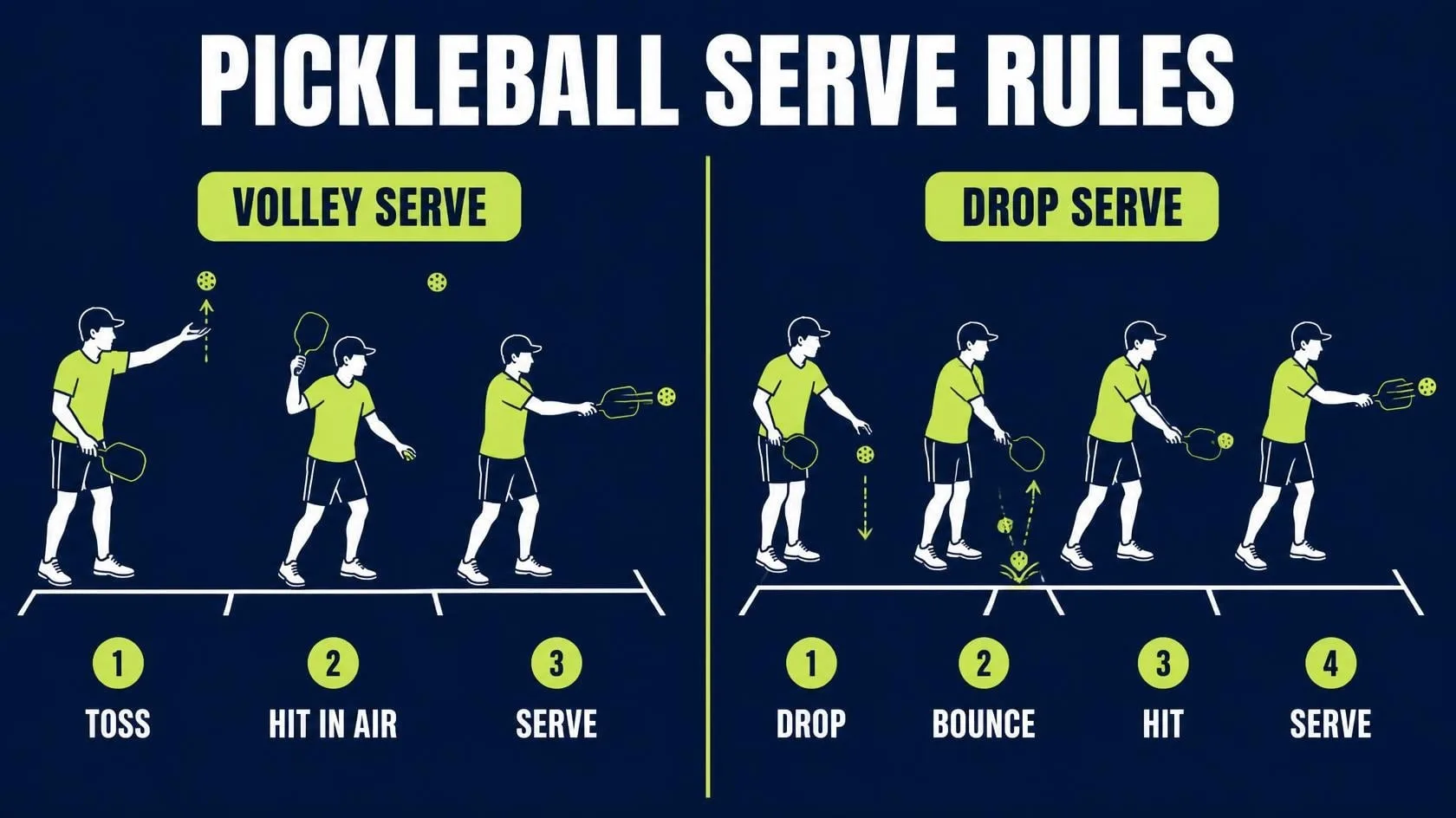
Pickleball serve rules make the serve the only shot in pickleball where the rulebook tells you exactly how your body is allowed to move. Get the motion wrong and it does not matter where the ball lands. It is a fault before the rally even starts.
Most rec court arguments come from the same four things: contact height, feet, spin, and time. This guide walks through all of it in plain language, checked against the current USA Pickleball Official Rulebook.
Quick answer: A legal serve starts behind the baseline with the score fully called. Hit it diagonally into the opposite service box so it clears the kitchen. A volley serve must be struck with an upward arc, below your waist, with the top of the paddle head below the top of your wrist. A drop serve skips those three tests, but the ball has to be dropped cleanly, with no push and no spin added by hand. One serve attempt only, and 10 seconds once the score is called.
The Legal Serve in Plain Steps
A legal serve comes down to six steps:
- Stand behind the baseline, inside the imaginary extensions of the sideline and centerline for your side.
- Wait until the full score has been called. Hitting the serve while the score is still being called is a fault.
- Release the ball from one hand, or let it roll off the paddle face by gravity alone. Do not spin it or flick it.
- Hit it with a legal motion, either a volley serve out of the air or a drop serve after a bounce.
- Send it diagonally into the opposite service box, past the kitchen.
- Do it within 10 seconds of the score call finishing.
Volley Serve vs Drop Serve
Under pickleball serve rules, you have exactly two ways to serve. They share the same foot rules, target, and release rules. What differs is the swing itself.
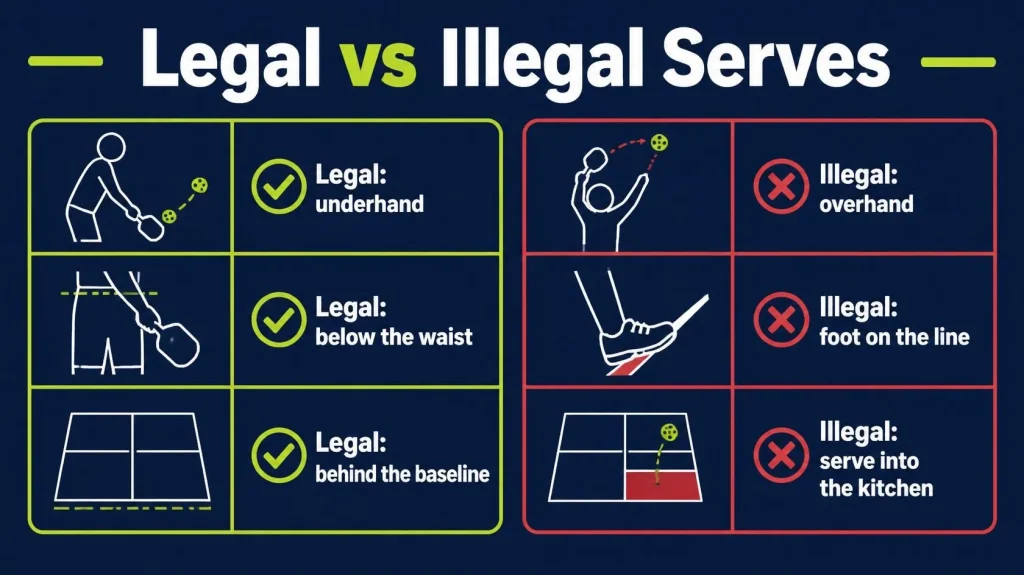
The volley serve is the classic serve, hit out of the air before it bounces. Three tests decide whether it was legal, and the current rulebook says each one has to be clearly met:
- Upward arc. Your paddle has to be moving upward through the ball at contact. A downward chop or a flat swat is a fault.
- Below the waist. The ball has to be contacted below your waist, with your navel as the usual reference point.
- Paddle head below the wrist. The highest point of the paddle head cannot be above the highest part of your wrist at contact.
The drop serve is the alternative, and it is far more forgiving. You drop the ball, let it bounce, then hit it. None of the three tests above apply. You can contact the ball above your waist and swing from any angle. The rules instead police the drop itself:
- Drop the ball from a natural, unaided height. You cannot throw it down at the court to juice the bounce, and you cannot toss it upward.
- Do not propel the ball in any direction as you let go.
- After that, the ball can bounce as many times as you want, anywhere on the playing surface, before you hit it.
| Rule | Volley serve | Drop serve |
|---|---|---|
| Contact point | Out of the air, before any bounce | After the ball bounces |
| Motion tests | Clear upward arc, ball below the waist, paddle head below the wrist | None of the volley tests apply |
| Ball release | One hand, or rolled off the paddle face by gravity | Dropped from a natural height, no push or toss |
| Spin by hand on release | Not allowed | Not allowed |
| Spin from the paddle at contact | Allowed | Allowed |
| Bounces before you hit it | Zero | Unlimited, anywhere on the playing surface |
Foot Faults on the Serve
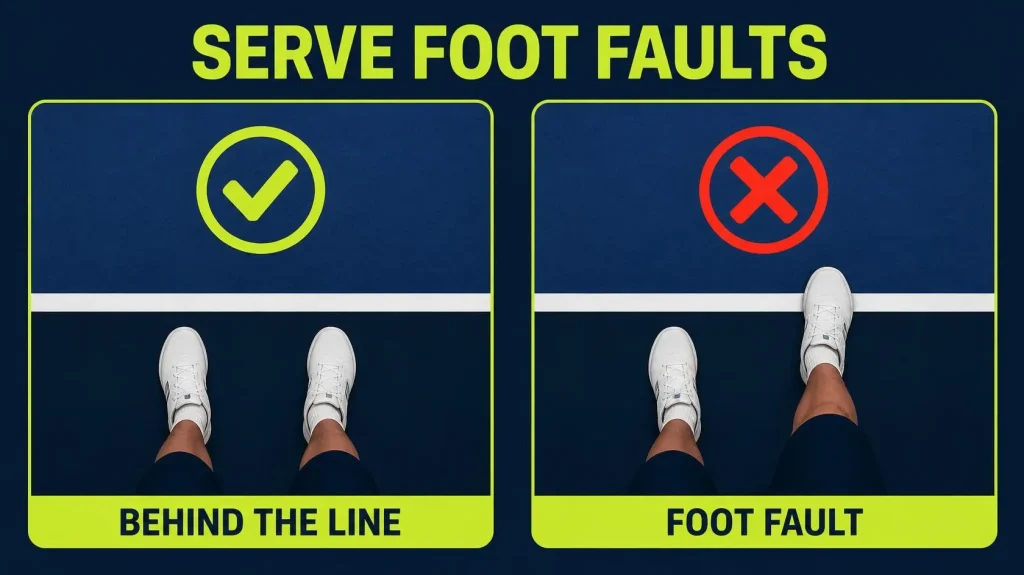
Foot faults are the most common serving fault in rec play, and most players who commit them never notice. The rules apply at the moment your paddle strikes the ball:
- At least one foot has to be on the ground behind the baseline.
- Neither foot can touch the baseline or the court in front of it.
- Neither foot can touch the ground outside the imaginary extensions of your sideline and centerline.
Pro tip: That last one catches people out. Stand too wide, outside the line of your service box extended backward, and you have faulted even with both feet behind the baseline. There are no jump serves either: one foot planted on the ground behind the line keeps you legal.
After contact, your momentum can carry you forward into the court. That is fine: the restrictions only cover the instant you hit the ball. Standing a few inches behind the baseline fixes most of it.
The Serve Must Clear the Kitchen
Where the ball lands matters as much as how you hit it. The serve has to travel diagonally into the service box opposite you, and it has to clear the non-volley zone, the 7-foot area everyone calls the kitchen. Our guide to the kitchen rules covers that zone in full. Once the serve clears it, rallies often move into soft kitchen play.
- A serve that lands in the kitchen is a fault.
- A serve that lands on the kitchen line is also a fault. That line belongs to the kitchen, and the serve is the one shot where touching it loses the rally.
- A serve that lands on any other line of the correct box is good.
- A serve that clips the net and lands in the correct box is live. Pickleball has no let serves. One that lands in the kitchen or outside the box after clipping the net is a fault.
- A serve that hits a permanent object, or hits you or your partner before it lands, is a fault against your team.
Types of Serves, in Plain Words
Once the motion is legal, you can shape the serve a few different ways. All of these are fine under the rules, because spin and pace created by the paddle at contact are legal.
- Drive serve. Flat and fast, aimed deep. It pressures weak backhands but leaves less margin over the net.
- Lob serve. High and deep. The ball drops steeply near the baseline and gives the receiver an awkward bouncing ball to judge. Wind can bully it, so pick your moments.
- Spin serve. Topspin, slice, or sidespin brushed on at contact. Legal, as long as the spin comes from the paddle during the swing, not from your fingers during the release.
A slower, safer deep serve is fine too: a serve that lands in beats a highlight serve that faults. And both serve types allow a forehand or backhand motion, if you want to change the look.
Spin Serves: What Is Banned and What Is Not
Spin created by your paddle at the moment of contact is legal. Slice it, brush topspin on it, cut it sideways. Play on.
Spin added to the ball before contact is banned. USA Pickleball banned the chainsaw serve in 2022. That was the release where the server spun the ball off the paddle or fingers so it was already rotating wildly before the swing. A wider ban followed in 2023, covering any manipulation or spin added by hand during the release, on either serve type. Natural rotation is fine: a ball released from a hand turns a little on its own. The rule targets deliberate spin, not physics.
The Nasty Nelson
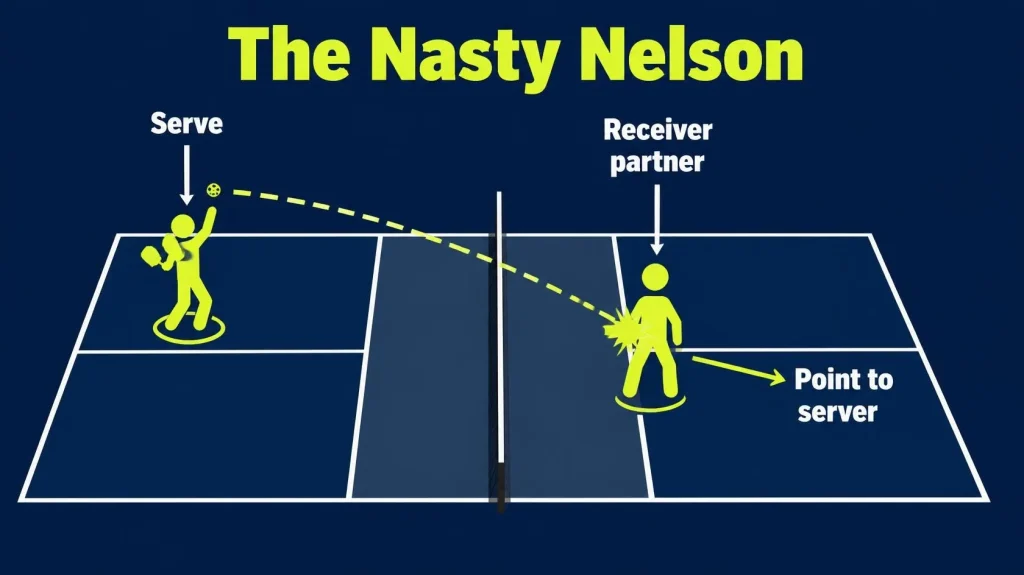
The Nasty Nelson is a serve deliberately aimed at the receiver’s partner, the player standing up near the kitchen line who is not returning the serve. It is named after pro player Tim Nelson, who made a habit of it.
Here is why it works. If a serve clears the net, or clips the net on the way over, and then touches the receiver or the receiver’s partner before it bounces, the rally ends and the point goes to the serving team. It does not matter where the partner is standing. Ten feet out of bounds, back turned, paddle down. Touch them, or anything they are wearing, before the bounce and the point is lost.
Pro tip: The defense is simple: watch the server, keep your paddle still and low, and step aside. A serve that never touches you still has to land in the correct box to be good, and a Nelson attempt that misses everyone and lands wide is just a fault on the server. Legal? Completely. Popular in rec play? Not remotely.
Receiver Faults: The Other Side Can Lose the Rally Too
Servers get most of the scrutiny, but the receiving team has its own ways to hand over a rally:
- Volleying the serve. The serve must bounce before it is returned. Hit it out of the air and the rally is over, your fault.
- Touching a serve that was heading for the kitchen. Let it land. A serve that bounces in the kitchen or on its line is a fault on the server, and you win the rally for doing nothing. Catch it or swat it before the bounce and the point flips to the serving team.
- The wrong receiver returns it. In doubles, only the player diagonally opposite the server may return the serve. If the partner steps in and takes it, that is a fault. The doubles rules explain how receiver positions are set.
- Delaying after the call. Once the score has been called and the server starts the motion, the receiving team cannot call a timeout or stop play to debate the score. Questions belong before the call.
- Not being ready, legally. Before the call, raise your paddle above your head, raise your non-paddle hand, or turn your back fully to the net. Any of those is a not-ready signal and the server has to wait. Once the call starts, the signals stop working, except to flag a genuine hinder like a stray ball.
The 10-Second Rule and Calling the Score
Under pickleball serve rules, serving runs on a small clock. The entire score must be called before the serve is hit, and the serve has to leave your paddle within 10 seconds of the call finishing.
- Singles: call two numbers, your score then your opponent’s. The singles rules explain how your score picks your serving side.
- Doubles: call three numbers: your team’s score, the other team’s score, then your server number, 1 or 2. Every game starts at 0-0-2, because only one server serves before the first side out.
- Timing faults. Hitting the serve while the score is still being called is a fault, and so is serving after the 10 seconds run out. Wait for the last number, then go.
- Swapping sides resets the clock. If the serving team changes serving areas after the call, everyone repositions, the score is called again, and the 10 seconds start fresh.
- Wrong score called? Speak up before the return of serve. The correct score gets called and the serve is replayed with no penalty. Stop play on a score that was actually right and the fault is yours.
What Changed in Recent Rule Updates
Pickleball serving rules have moved a lot in the last few years. The changes that matter today:
- The chainsaw serve was banned in 2022, and in 2023 the ban grew to cover any spin or manipulation added by hand during the release. Paddle spin at contact never went away.
- The release must be visible. The receiver has to see the ball leave your hand. Hide it and the receiver can ask for a replay before returning.
- You can now release the ball off the paddle face. A 2025 change lets the ball roll off the paddle by gravity alone. No flick, no push, no added spin.
- The 2026 rulebook tightened the three volley serve tests. Each now has to be clearly met: a clear upward arc, the paddle head clearly below the wrist, the ball clearly below the waist. Borderline serves that used to get a shrug get called, so the drop serve is the smart fix if yours lives on that line.
- The serve rules also have a new home. The current book puts them in Section 7, with score calling and the 10-second rule in Section 6. Older guides cite Section 4, which is why rule numbers differ between websites.
Pickleball Serve Rules: Legal vs Illegal Serve Checklist
Legal:
- Ball contacted below the waist, paddle swinging upward, paddle head below the wrist (volley serve)
- Ball dropped cleanly and hit after the bounce, any swing you like (drop serve)
- Feet behind the baseline, inside your sideline and centerline extensions, at contact
- Serve lands deep in the diagonal box, past the kitchen
- Serve clips the net and lands in
- Spin brushed on by the paddle at contact
- Score fully called, serve hit within 10 seconds
Illegal:
- Overhand motion, or any volley serve contacted at or above the waist
- Paddle head above the wrist at contact
- Foot touching the baseline, or standing outside your service area extensions, at contact
- Serve landing in the kitchen or on the kitchen line
- Serve hit before the score call finished, or after the 10-second window
- Ball spun by hand or scraped down the paddle during the release
- Serve hitting the net post, a permanent object, or your own partner
Frequently Asked Questions
Can you bounce the ball before serving in pickleball?
Yes. That is the drop serve. Drop the ball from a natural height, let it bounce as many times as you like, anywhere on the playing surface, then hit it. The drop serve is exempt from the upward arc, below the waist, and paddle head rules that govern the volley serve, but the drop itself has to be clean: no throw, push, or added spin.
Can you serve overhand in pickleball?
No. An overhand motion fails the volley serve tests: the paddle is not moving upward through the ball in the required way and contact happens above the waist. Use a drop serve instead: once the ball has bounced, the motion restrictions disappear.
Is the chainsaw serve legal?
No. The chainsaw serve, where the ball was spun off the paddle or fingers before the swing so it rotated wildly off the bounce, was banned in 2022. A broader rule followed in 2023, banning spin or manipulation added by hand during any serve release. Spin is still legal when your paddle creates it at contact.
What happens if the serve hits the net?
It depends where the ball lands. If it clips the net and lands in the correct service box, the serve is live and the rally continues. Pickleball has no let serves. If it hits the net and lands in the kitchen, on the kitchen line, or outside the correct box, it is a fault on the server.
Do you get a second serve in pickleball?
No. You get one serve attempt. A fault means the serve passes to your partner in doubles, or to the other team on a side out. The exceptions are replays: a hidden release, spin added during the release, or a corrected score call can restart the serve with no penalty.
What is a foot fault on the serve?
A foot fault happens at the moment of contact if a foot touches the baseline or the court in front of it, if no foot is on the ground behind the baseline, or if a foot touches the ground outside the imaginary extensions of your sideline or centerline.
How long do you have to serve after the score is called?
Ten seconds, counted from the moment the score call finishes. Serving before the call is finished is a fault, and so is serving after the 10 seconds run out. If the serving team swaps sides after the call, the score is called again and the count restarts.
Can you catch a serve that is obviously going out?
No. Touch the served ball before it bounces, with your body, paddle, or anything you are wearing, and the rally is over. The point goes to the serving team, even if the ball was flying ten feet long. Let it land. The same goes for a serve dropping into the kitchen: let it bounce and the fault is theirs.
Checked: October 25, 2026, against the 2026 USA Pickleball Official Rulebook.
4 Comments