
Can You Play Pickleball on a Tennis Court? Setup Guide
Home > Guides > Can You Play Pickleball on a Tennis Court? Setup Guide
Court Setup
✓Can you play pickleball on a tennis court? Yes.
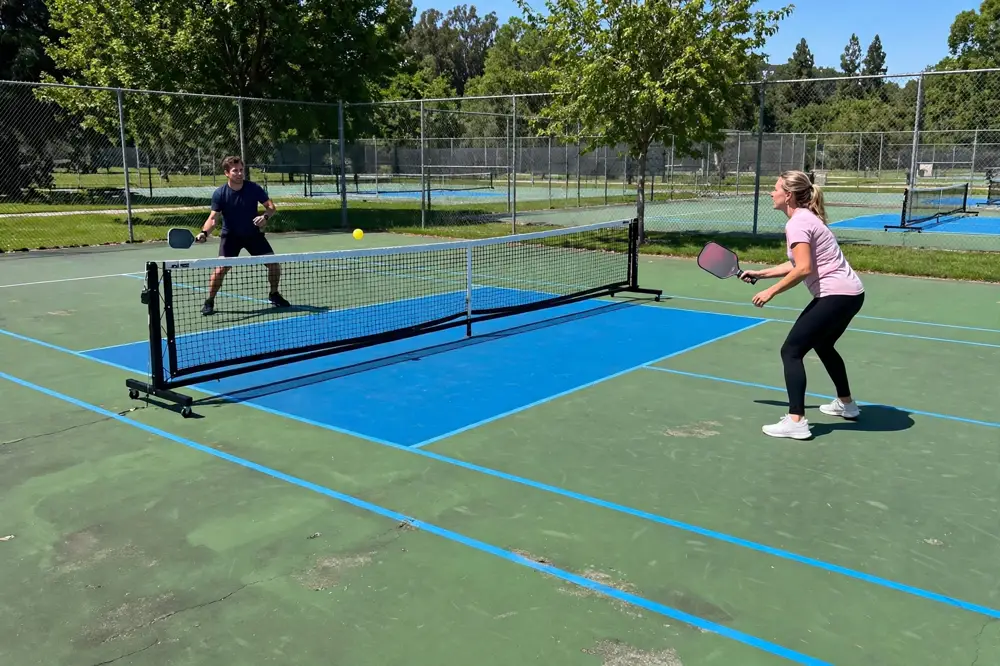
Yes, you can play pickleball on a tennis court, and it is how many players get their first game. A pickleball court is small enough to fit inside a tennis court with room to spare, the surfaces are the same hard court family, and the only things you need to change are the lines and the net height.
One tennis court can hold a single pickleball court for a casual game, two courts for a group, or four courts when a club wants maximum capacity. This guide gives you the exact measurements for all three layouts, so you can mark lines with confidence instead of guessing. It also covers temporary setup with tape and chalk, net height fixes, what a permanent conversion involves and costs, which ball to use, and how to share a court without upsetting the tennis players.
This is the full walkthrough promised in our court dimensions guide, where the 1, 2, and 4 court layouts were held back for their own article. If you need the official pickleball measurements first, that guide has them line by line.
Quick answer: pickleball on a tennis court in 30 seconds
- Yes, a pickleball court (20 feet by 44 feet) fits comfortably inside a tennis court (36 feet by 78 feet for doubles).
- One tennis court can hold 1, 2, or 4 pickleball courts. Four is the maximum.
- The simplest setup is one centered court using the tennis net lowered to 34 inches at center, or a portable pickleball net.
- Mark lines with tape or chalk for temporary play, or paint them in a contrasting color for a permanent shared court.
- A portable pickleball net gives the exact heights (36 inches at the sidelines, 34 inches at center). A lowered tennis net gets the center right but stays high toward the posts.
- Use an outdoor pickleball ball on a converted tennis court, because the surface is hard and the ball needs to cut through wind.
- Get permission before marking lines or adjusting the net on any court you do not own.
The short answer: yes, and why it works
The fit is not close, it is generous. A doubles tennis court covers 2,808 square feet of playing lines, while a pickleball court covers 880 square feet. The full fenced tennis pad is usually about 60 feet by 120 feet, which is why four pickleball courts can share one tennis enclosure even though a single tennis court looks like it holds far less.
The surfaces match too. Most tennis courts are acrylic coatings over asphalt or concrete, and that is the same surface family dedicated pickleball courts use. You are not asking a ball to bounce on a surface it was never made for. Fencing, lighting, and drainage are already in place, which is why parks departments convert underused tennis courts instead of building from scratch.
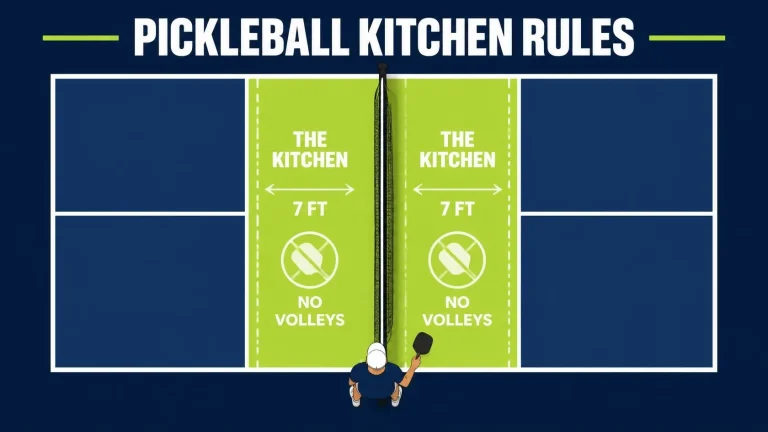
Only three things actually change between the two sports on the same slab: the lines on the ground, the net height, and one zone that tennis does not have. Pickleball has a 7 foot non-volley zone on each side of the net, the kitchen, and tennis has nothing like it. Our kitchen rules guide explains what you can and cannot do inside that zone, and you will need its lines marked before any game on a tennis court feels right.
The measurements that make it fit
| Measurement | Tennis court | Pickleball court |
|---|---|---|
| Length, baseline to baseline | 78 feet | 44 feet |
| Width, doubles | 36 feet | 20 feet (same for singles and doubles) |
| Width, singles | 27 feet | 20 feet (same for singles and doubles) |
| Net height at center | 36 inches (3 feet) | 34 inches |
| Net height at posts or sidelines | 42 inches (3 feet 6 inches) | 36 inches |
| Distance between net posts | 42 feet (3 feet outside each doubles sideline) | 22 feet (1 foot outside each sideline) |
| Service line or kitchen line from net | 21 feet (tennis service line) | 7 feet (kitchen line) |
| Line width | 2 inches (baseline up to 4 inches) | 2 inches, measured to the outside edge |
| Full pad, including runback | About 60 feet by 120 feet | Minimum playing surface 30 feet by 60 feet |
Two gaps in that table explain most of the conversion. First, the tennis net is 2 inches too high at center and 6 inches too high at the posts for pickleball. Second, the tennis service line sits 21 feet from the net while the pickleball kitchen line sits 7 feet from the net, so the kitchen line lands 14 feet inside the tennis service line. Keep those two numbers in mind and every layout below falls into place.
Layout 1: one court, centered on the tennis court
This is the easiest setup, the best choice for a first game, and the only layout that keeps the tennis court fully playable at the same time. Center one 20 foot by 44 foot pickleball court on the tennis court, running the same direction as tennis, with the tennis net (lowered) or a portable net at the center line.
Walk through it in this order:
- Find the center of the tennis court. The tennis net line is your middle. Mark the center point of the net line, then measure 10 feet to each side along it. Those two points are where your pickleball sidelines meet the net.
- From each of those points, measure 22 feet toward each tennis baseline along the sideline direction. That gives you the four corners of a 20 foot by 44 foot rectangle. Check the diagonals if you want to be sure the rectangle is square: both diagonals should measure the same.
- Mark the baselines, 20 feet across each end, and the sidelines, 44 feet down each side. Your pickleball baselines will sit 17 feet inside the tennis baselines at each end, because 78 minus 44 leaves 34 feet, split evenly as 17 feet each end. Your sidelines will sit 8 feet inside the doubles sidelines on each side, because 36 minus 20 leaves 16 feet, split evenly as 8 feet each side.
- Mark the kitchen lines, 20 feet across, at 7 feet from the net on each side. As a check, each kitchen line should sit 14 feet inside the nearest tennis service line, since the tennis service line is 21 feet from the net and 21 minus 7 is 14.
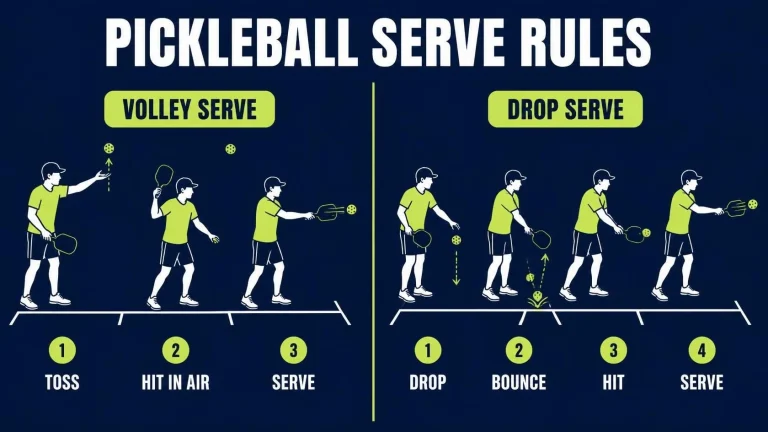
- Mark the centerline on each side, 15 feet long, from the kitchen line to the baseline, splitting each half into two 10 foot by 15 foot service boxes. Our serve rules guide explains why the serve must land in the diagonal box and clear the kitchen, which is the reason the centerline matters even in a casual game.
For the net, you have two choices. Lower the tennis net with the center strap until the center measures 34 inches, which is close enough for casual play, or set a portable pickleball net at the center line for exact heights. One drawback of the tennis net option: the tennis net spans 42 feet between its posts, far wider than the 22 foot pickleball net, so it blocks around the post shots and stays higher than 36 inches out near the posts. If your group plays around the post shots, use a portable net.
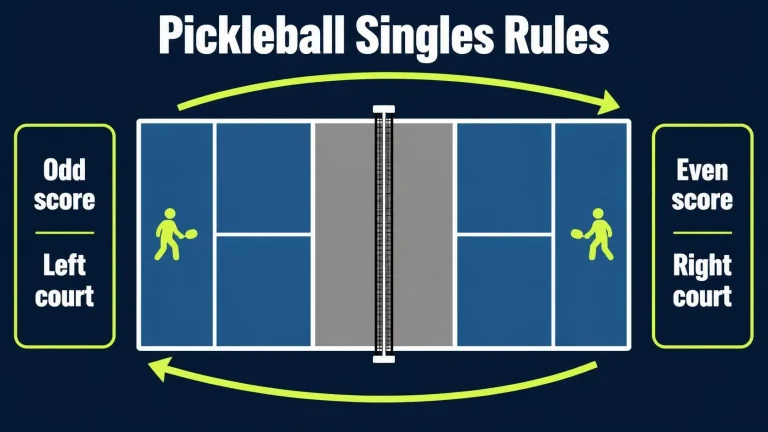
This layout leaves generous room everywhere: 17 feet of runback behind each pickleball baseline before you even reach the tennis baseline, plus the tennis runback beyond it, and 8 feet to each doubles sideline plus the side runback to the fence. It is the most forgiving layout for beginners and the least disruptive to tennis players sharing the court. The same lines serve singles and doubles, since both formats use the same 20 foot by 44 foot court, and our singles rules guide covers how scoring and serving work when it is just one player per side.
Layout 2: two courts on one tennis court
Two courts suit a group of 8 players or a small clinic, and there are two practical ways to place them. The version most conversion guides describe puts one court on each half of the tennis court.
In this version, each pickleball court sits within one tennis half, with its net at the center of that half’s open ground between the tennis service line and the tennis baseline (the area tennis players call no man’s land). That center point is 30 feet from the tennis net, halfway between the service line at 21 feet and the baseline at 39 feet. The court extends 22 feet each way from its net, so one baseline lands 8 feet from the tennis net and the other lands 13 feet past the tennis baseline into the runback area. The tennis net stays in place between the two courts and works as a backstop for both.
The second version places both courts side by side, turned 90 degrees from the tennis orientation, so the pickleball nets run parallel to the tennis sidelines instead of parallel to the tennis net. Each court still measures 20 feet by 44 feet, and the pair spans the width of the tennis pad, which is about 60 feet including side runback, leaving roughly 8 feet of side room on each side. The tennis net is not used for play in this version, it simply divides the space.
Both versions need portable nets, because the tennis net cannot serve two pickleball courts at once. Mark the lines the same way as the single court layout, one court at a time, and measure each court from its own net line rather than copying marks across. In the one court per half version, the inner baselines of the two courts sit 16 feet apart at the center (8 feet plus 8 feet), which gives players a shared buffer zone but means loose balls will cross between courts often. Agree before play that a ball rolling onto the other court waits for a break in their rally.
Layout 3: four courts on one tennis court
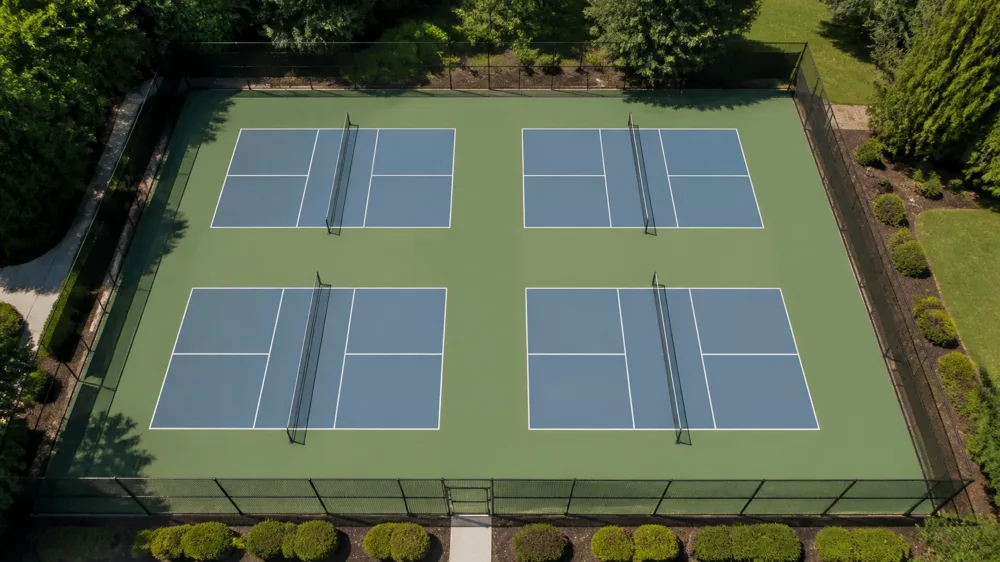
Four is the maximum, and it is the layout parks and clubs use when demand is high. Divide the tennis pad into four quadrants, with two courts on each side of the tennis net line, all four turned 90 degrees from the tennis orientation so their nets run perpendicular to the tennis net.
The pad math is what makes this work. A standard tennis pad is about 60 feet by 120 feet. Split at the tennis net line, each half is about 60 feet by 60 feet, and each half holds two pickleball courts side by side. Each court runs 44 feet across the 60 foot width of the pad, leaving about 8 feet of side room on each side. Along the length, two 20 foot courts take 40 feet of the 60 foot half, leaving about 20 feet to split between the gap at the tennis net, the gap between the courts, and runback at the outer end. Conversion guides recommend at least 5 feet of space between neighboring courts, so plan your gaps rather than pushing courts tight against each other.
Four courts mean 16 players at once, which is the real payoff. The tradeoff is clearance. The recommended 10 feet of overrun outside each pickleball boundary line does not survive in a four court conversion, and balls will roll onto neighboring courts. That is acceptable for social play, open play sessions, and practice, but it is tight for competitive matches where a stray ball stops a rally. If your group plays at a competitive level, two courts with proper runback will give better games than four cramped ones. For how doubles scoring and serving rotation work on these courts, see our doubles rules guide.
Comparing the three layouts
| Layout | Courts | Orientation vs tennis | Nets needed | Lines to mark | Runback and clearance | Best for |
|---|---|---|---|---|---|---|
| 1 court, centered | 1 | Same direction as tennis | 1 (lowered tennis net or portable net) | 1 set: 2 baselines, 2 sidelines, 2 kitchen lines, 2 centerlines | Generous: 17 feet behind each baseline to the tennis baseline, 8 feet to each doubles sideline | Casual games, beginners, shared courts that still host tennis |
| 2 courts | 2 | One per tennis half, same direction; or side by side, turned 90 degrees | 2 portable nets | 2 sets | Good on the outer ends, tighter in the middle (16 feet between inner baselines in the per half version) | Groups of 8, clinics, small social sessions |
| 4 courts | 4 | Turned 90 degrees, two per side of the tennis net | 4 portable nets (or permanent posts for a full conversion) | 4 sets | Tight: about 8 feet at the sides, at least 5 feet between neighboring courts, below the recommended 10 foot overrun | Clubs, open play, maximum capacity on one slab |
Temporary setup: tape, chalk, and portable nets
Temporary lines are the right call for any court that still hosts tennis, and for any first attempt at a layout. You need a 50 foot or longer measuring tape, court marking tape or sidewalk chalk, a straight edge or a second person to hold the tape line, paddles, and balls. A portable net completes the kit if you are not using the tennis net.
Mark in this order:
- net line position first
- sidelines
- baselines
- kitchen lines
- centerlines
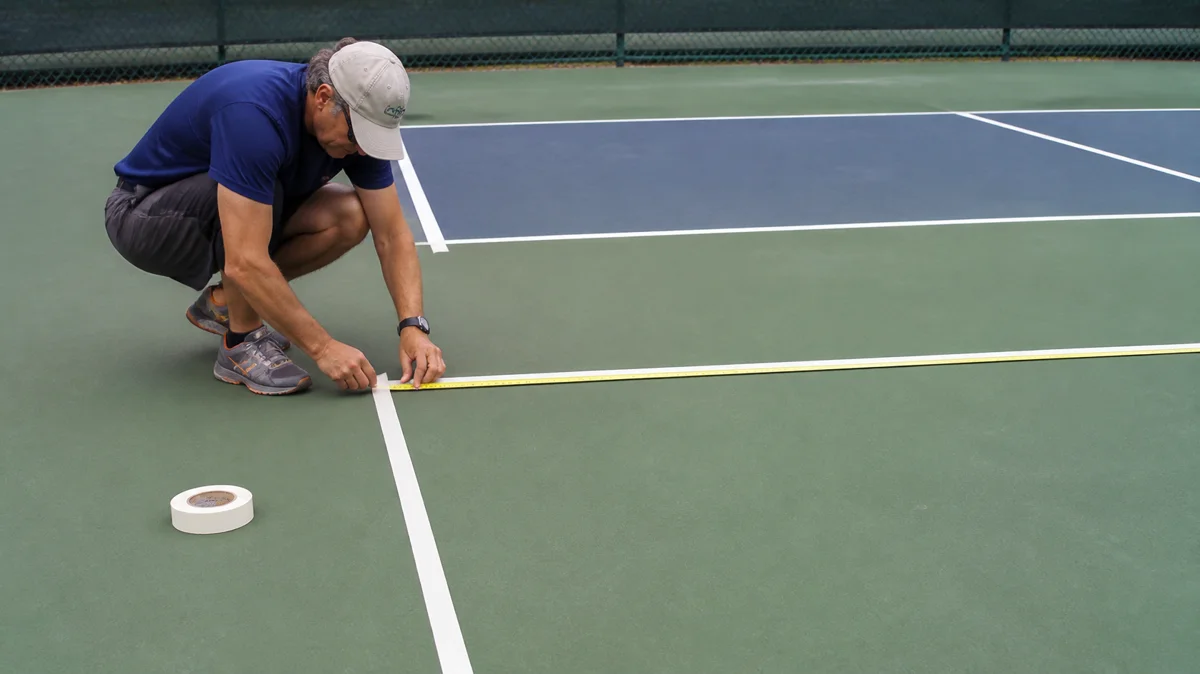
Measuring from the net outward keeps errors from stacking up at the far end. Remember that pickleball lines are 2 inches wide and measurements go to the outside edge of the line, so place the outer edge of your tape or chalk on the measured mark, not the center of it.
Tape gives the cleanest lines and survives a full session, but it takes longer to lay and you must peel it up when you finish. Chalk is the fastest option and washes away, but it fades under foot traffic and blows around on a windy day. Painter’s tape works for a single session on a clean, dry court; purpose made court tape grips better and leaves less residue. Never use permanent paint on a shared court without written permission from whoever manages it, because painted lines change the court for every other user.
For a court that hosts both sports permanently, the standard solution is blended lines: pickleball lines painted in a contrasting color to the tennis lines, often blue against white, so players can tell the two sets apart at a glance. Agree the color with the facility before painting, and keep the pickleball lines the same 2 inch width so neither sport’s lines dominate the surface.
For planning, allow 30 to 60 minutes to measure and tape your first court, and less once you know the marks and have a routine. A second person holding the tape cuts the time sharply, because most of the work is walking measurements, not laying tape.
Net setup and height adjustments
Net height is the one adjustment players most often skip, and it changes the game more than people expect. A tennis net at full height is 2 inches too high at center and 6 inches too high at the posts for pickleball, which turns soft dinks into net cords and makes the kitchen game feel wrong.
To use the tennis net, find the center strap and tighten it until the center of the net measures 34 inches from the surface. Measure with a tape, not by eye. Check the height at the sidelines too, and accept that it will read higher than the pickleball spec of 36 inches near the posts, because the tennis net is built to sag from 42 inches at the posts to 36 inches at center. Lowering the center to 34 inches does not fix the sides. Restore the tennis net to its normal height when you finish, so the next tennis players are not served a surprise.
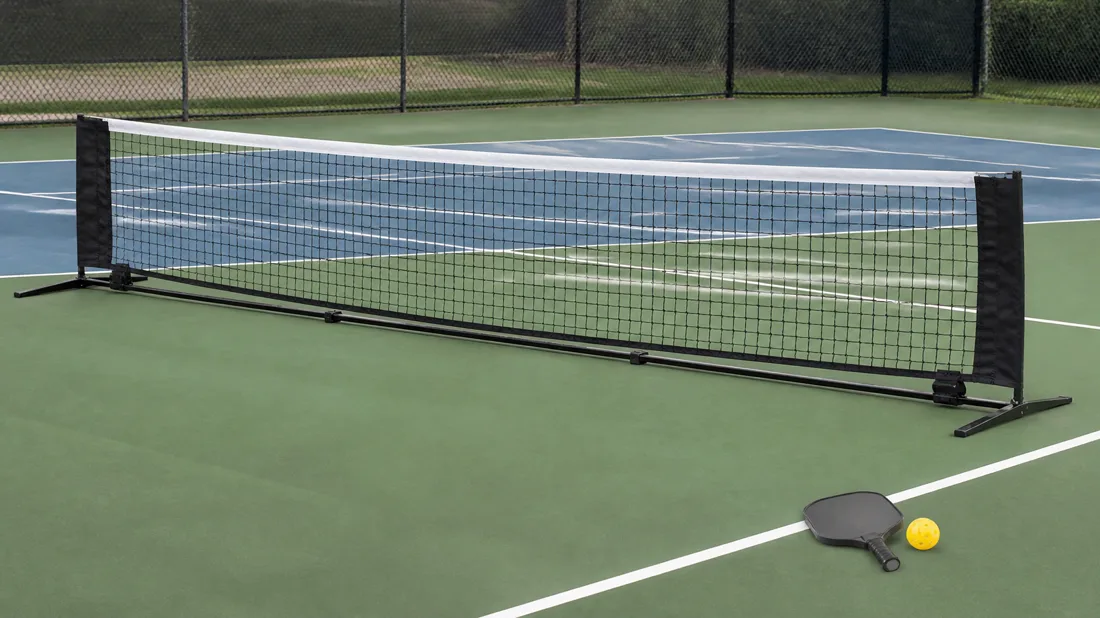
A portable pickleball net removes the guesswork. Set the posts 22 feet apart, one foot outside each sideline, and check 36 inches at the sidelines and 34 inches at center before the first serve. Portable nets also let you use the tennis net as a backstop behind one baseline, which stops long balls from rolling across the whole facility. When you place a portable net on one half of a tennis court, leave enough room behind each baseline for players to move, at least the 8 feet of a minimum pickleball playing surface, and more if the space allows.
Permanent conversion basics and what it costs
A permanent conversion means painted lines, proper net posts, and usually a resurfaced slab. It suits a facility that has committed to pickleball, or a shared court where both sports have agreed on blended lines and the layout is settled.
The work typically runs in this order:
- agree the layout and line color
- repair cracks and low spots in the slab
- apply an acrylic resurfacer and color coats
- paint the pickleball lines (and repaint tennis lines if the court stays shared)
- install net post sleeves for each court or adjustable dual sport posts that switch between tennis and pickleball heights
A full dedicated conversion also removes the tennis net posts and center anchor, which is the step that makes the change hard to reverse, so do not take it on a court that still hosts regular tennis.
Cost guides for 2026 put a full conversion of one tennis court into four pickleball courts at roughly 5,000 to 20,000 dollars, covering resurfacing, new lines, net systems, and sometimes lighting upgrades. The range is wide because surface condition drives the price: a sound slab that only needs lines and nets sits near the bottom, while a cracked slab that needs repair and full resurfacing sits near the top. For the pieces separately, line painting alone is often quoted at 200 to 500 dollars per court in one guide and 500 to 2,500 dollars in another, portable nets run about 100 to 150 dollars each, permanent dual sport post systems run about 500 to 1,200 dollars, and resurfacing a single court pad runs about 3,000 to 7,000 dollars. A full dedicated rebuild with new posts for all four courts and a fresh surface can pass 20,000 dollars and reach 50,000 dollars or more.
✓Pro tip: Treat every figure here as a planning range, not a quote. Prices vary by region, surface condition, and what the contractor includes. Get several written quotes for the same scope, ask whether permits and site preparation are included, and check with your city, county, or homeowners association before signing anything, since fencing, lighting, or drainage changes often need approval.
Surface and ball considerations
Most tennis courts convert cleanly because the surface is already right. Acrylic over asphalt or concrete gives a consistent bounce, enough grip for quick lateral movement, and a ball response close to a dedicated pickleball court. If the tennis surface is heavily textured or worn smooth in patches, expect the ball to play slightly faster or skid in the worn areas, and factor a resurface into the conversion plan.
Clay and grass tennis courts are the exception. Tape and chalk will not hold on a loose clay surface, painted lines do not survive regular dragging and watering, and the ball behaves very differently on both. A clay or grass tennis court is not a practical pickleball conversion without a hard surface laid over it, which is a different project from lining a hard court.
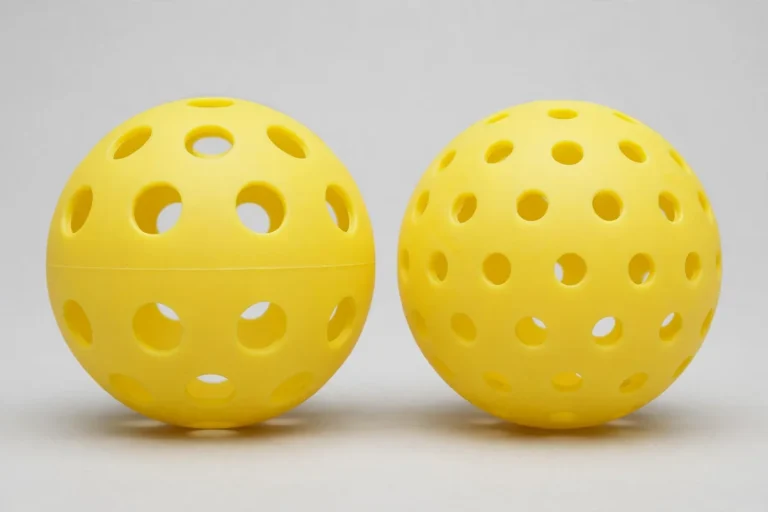
Ball choice matters as much as surface. On a converted tennis court, which is a hard outdoor surface, use an outdoor pickleball ball: 40 smaller holes, harder plastic, and a weight near 0.9 ounces, built to cut through wind and survive rough surfaces. An indoor ball has 26 larger holes, softer plastic, and a weight near 0.8 ounces, and it is made for smooth gym floors where there is no wind and control matters more than durability. An indoor ball on a tennis court will feel slow, wear fast, and crack sooner on the rough surface. The official ball spec covers both types: 2.87 to 2.97 inches in diameter, 0.78 to 0.935 ounces in weight, and a bounce of 30 to 34 inches when dropped from 78 inches.
One more layout detail that costs nothing: outdoor court orientation. USA Pickleball construction guidance recommends running the long axis of an outdoor court north to south, so players are not staring into the sun during morning and evening play. Check which way your tennis court runs before painting permanent lines, because a rotated four court layout changes which direction players face.
Etiquette for shared courts
Most conflicts on converted courts are not about rules, they are about respect for the other sport’s players. A few habits keep shared courts friendly.
✓Pro tip: Get permission first, from whoever manages the court, before marking lines, lowering a net, or painting anything. If the court has a posted schedule, play in the pickleball slots and do not run over into a tennis booking. If there is no schedule, favor off peak times for setting up temporary lines, since a taping session occupies the court without a game happening on it.
Leave the court as you found it. Peel up all tape, return the tennis net to its normal height, and pick up broken balls and tape scraps. A court left with tape residue or a sagging net is the fastest way to lose access.
Keep noise in mind. A pickleball is louder than a tennis ball, and the sound carries, especially in the early morning. Respect posted hours and keep voices down near homes. During play, wait for a break in a neighboring rally before crossing their court to fetch a ball, and never walk onto a live tennis point.
Finally, agree on line colors and calls before the first serve when both sports share painted lines. Two sets of lines confuse everyone at first, so name the color you are playing (for example, “blue lines are ours”) and call close balls clearly. A short conversation before play prevents most arguments during it.
Frequently asked questions
Can you play pickleball on a tennis court?
Yes. A pickleball court measures 20 feet by 44 feet and fits inside a tennis court with room to spare. Mark the pickleball lines with tape, chalk, or paint, set the net to 36 inches at the sidelines and 34 inches at center, and use an outdoor pickleball ball on the hard surface. One tennis court can hold up to four pickleball courts.
How many pickleball courts fit on one tennis court?
Four is the maximum, using the full fenced pad of about 60 feet by 120 feet, with two courts on each side of the tennis net line and all four turned 90 degrees from the tennis orientation. Two courts fit comfortably with better runback, and one centered court is the simplest setup of all. The right number depends on how much clearance your group is willing to give up.
Do I need a portable net, or can I use the tennis net?
Both work. A portable pickleball net gives the exact heights of 36 inches at the sidelines and 34 inches at center, and it lets you place courts anywhere on the slab. The tennis net works for a single centered court if you lower the center strap to 34 inches, but the sides stay higher than spec and the wide net blocks around the post shots. For two or four courts, portable nets are required, because the tennis net cannot serve more than one court.
What size is a pickleball court compared to a tennis court?
A pickleball court is 20 feet wide by 44 feet long, the same for singles and doubles. A tennis court is 78 feet long, 36 feet wide for doubles and 27 feet wide for singles. The pickleball court is roughly a third of the tennis court’s playing area, which is why multiple pickleball courts fit on one tennis slab.
How do I mark pickleball lines on a tennis court?
Measure from the net line outward: sidelines 44 feet long, baselines 20 feet across each end, kitchen lines 20 feet across at 7 feet from the net on each side, and centerlines 15 feet long from each kitchen line to its baseline. Lines are 2 inches wide and measurements go to the outside edge of the line. Use tape or chalk for temporary lines and paint in a contrasting color for a permanent shared court.
Can I leave pickleball lines painted on a shared tennis court?
Only with the facility manager’s permission. The accepted approach for a shared court is blended lines, with pickleball lines painted in a contrasting color to the tennis lines so both sets stay readable. Without permission, stick to tape or chalk and remove them when you finish, so the court is unchanged for the next tennis players.
What ball should I use on a converted tennis court?
An outdoor pickleball ball. Converted tennis courts are hard surfaces, usually acrylic over asphalt or concrete, and outdoor balls are built for exactly that: 40 smaller holes, harder plastic, and a weight near 0.9 ounces. Indoor balls have 26 larger holes and softer plastic for smooth gym floors, and they wear out quickly and play slowly on a rough outdoor surface.
Is the tennis court surface good for pickleball?
Yes, for hard courts. Acrylic over asphalt or concrete gives a consistent bounce and good grip, close to a dedicated pickleball court. Clay and grass tennis courts are the exception: lines will not hold on clay, and the ball behaves differently on both, so they are not practical conversions without a hard surface laid over them.
How much does it cost to convert a tennis court to pickleball?
Industry cost guides for 2026 put a full conversion of one tennis court into four pickleball courts at roughly 5,000 to 20,000 dollars, including resurfacing, lines, nets, and sometimes lighting. Line painting alone runs a few hundred dollars per court, portable nets run about 100 to 150 dollars each, and a full dedicated rebuild with new posts and a fresh surface can pass 20,000 dollars. Get local written quotes, because surface condition and region move the price a lot.
Can I play pickleball on a tennis court using only the tennis lines, with no new lines?
You can rally for fun, but it is not a real game. The tennis lines give you rough boundaries, but there is no kitchen line, the service boxes are the wrong size, and the court is far too long. Marking at least the baselines, sidelines, and kitchen lines takes little time with tape and turns a hit around into a proper match, so it is worth doing even for a casual session.
Sources and verification
Checked: October 25, 2026, against the 2026 USA Pickleball Official Rulebook as quoted by USA Pickleball sources, ITF tennis court dimensions, and 2026 court conversion and cost guides.
6 Comments