
Pickleball Singles Rules: Scoring, Serving, and Strategy
Home > Guides > Pickleball Singles Rules: Scoring, Serving, and Strategy
Rules
Pickleball singles rules start with a simple truth: singles pickleball is the same game you know, just with nowhere to hide. There is no partner to cover the middle, no one else to blame for a missed return, and a lot more court to cover on your own.
The good news: the rulebook barely changes. Almost every rule from doubles carries straight over. What changes is the scoring call, how you pick your serving side, and how much running you do.
This guide covers the official pickleball singles rules as they are actually played: side-out scoring, the two-number call, even and odd serving positions, plus skinny singles, a half-court variant most guides skip entirely.
Quick answer: pickleball singles rules in 30 seconds
✓Pickleball singles rules use side-out scoring on the full 20 by 44 foot court: only the server scores, games go to 11, win by 2.
- ✓ You play on the full court, 20 feet wide by 44 feet long. Singles does not use a smaller court.
- ✓ Only the server can score points. Win a rally on your serve and you get a point. Win a rally as the receiver and you only win the serve.
- ✓ The score is called with two numbers: your score first, then your opponent’s score. A call of 4-2 means the server has 4 and the receiver has 2.
- ✓ Your score picks your serving side. Even score, serve from the right. Odd score, serve from the left.
- ✓ Games are played to 11 points, and you must win by 2.
- ✓ The two-bounce rule and kitchen rules work exactly as in doubles.
How scoring works in singles
Singles uses side-out scoring, the traditional scoring system in the USA Pickleball Official Rulebook. It works on one simple idea: points only exist when you are serving.
Win a rally while serving and your score goes up by one. Lose a rally while serving and nobody scores. The serve just passes to your opponent. That pass is called a side out.
This is the part that trips up new players. You can play a brilliant rally as the receiver, force an error, and still not add a single point to your score. Your reward is the serve, and the chance to start scoring yourself.
Games are played to 11 points, win by 2. At 10-10, play continues until someone leads by two, so games can end 12-10 or 13-11. Some tournaments use 15 or 21 instead, still win by 2, but 11 is the standard for recreational play and most events.
There is no second server in singles. Doubles gives each team two serving turns per side out, with one famous exception at the start of a game. Singles is simpler: you serve until you lose a rally, then your opponent serves.
Side-out scoring
Side-out scoring means only the serving player or team can score points. When the server loses a rally, no point is awarded. The serve passes to the other side, and that handover is the side out. It is the traditional scoring system and the standard in the official rulebook.
The two-number score call
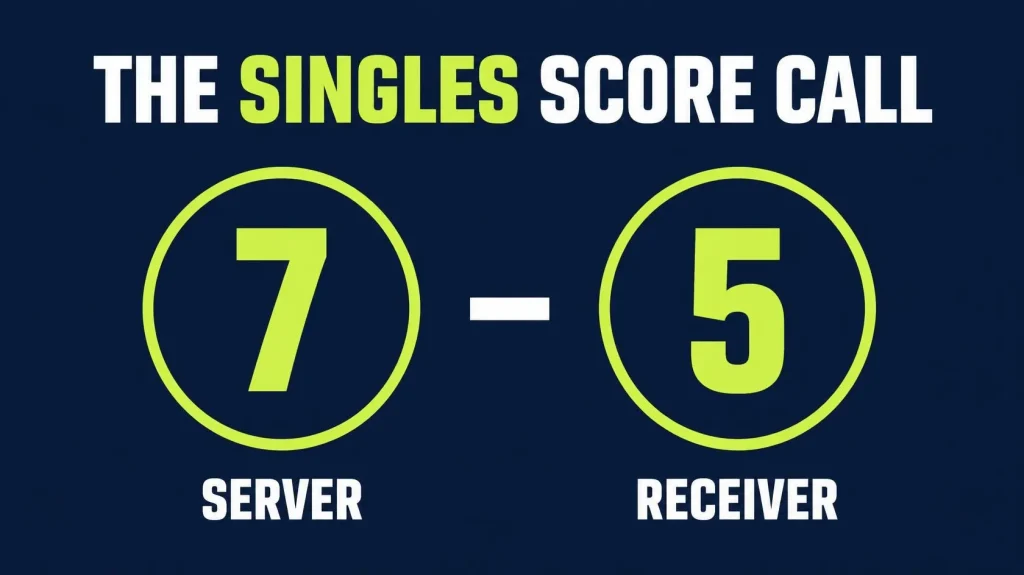
Before every serve, the server calls the score out loud. In singles, that call has exactly two numbers: the server’s score first, then the receiver’s score.
So if you are serving and the score is 7 points to you and 5 to your opponent, you call “7-5” and serve.
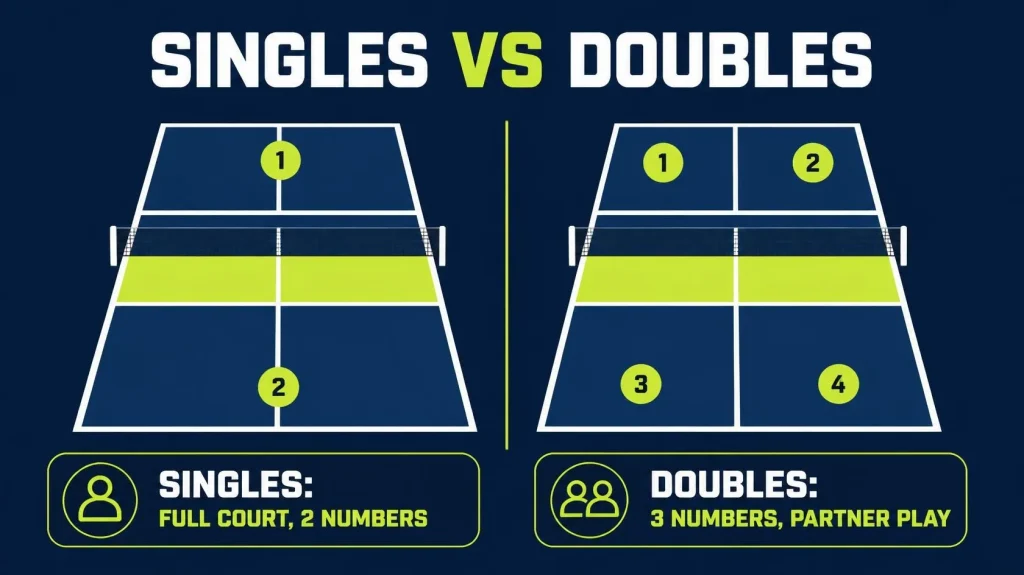
You will sometimes see singles described with a three-number call. That is wrong. Three numbers belong to doubles, where the third number says which partner is serving. With one player per side, there is no partner and no third number. If a guide or a well-meaning opponent insists on a third number in singles, they are mixing up the two formats.
Here is a short game start so you can see the call and the side switching work together:
- Score 0-0. You serve from the right side, because 0 is even. You win the rally. Point to you.
- Score 1-0. You switch to the left side, because 1 is odd. You serve and win again.
- Score 2-0. You switch back to the right side. This time you lose the rally. No point changes hands, but the serve does. Side out.
- Your opponent now serves at 0-2. Their score is 0, an even number, so they start from their right side. They win the rally.
- Score 2-1, with your opponent still serving, now from their left side. They win again.
- Score 2-2. They serve from the right side again. You win this rally as the receiver, so the serve comes back to you with the score still 2-2.
- You serve at 2-2 from your right side, because your score of 2 is even.
That is the whole system. Call two numbers, let your own score tell you where to stand, and only count points you win on your serve.
Your score picks your side: even and odd positions
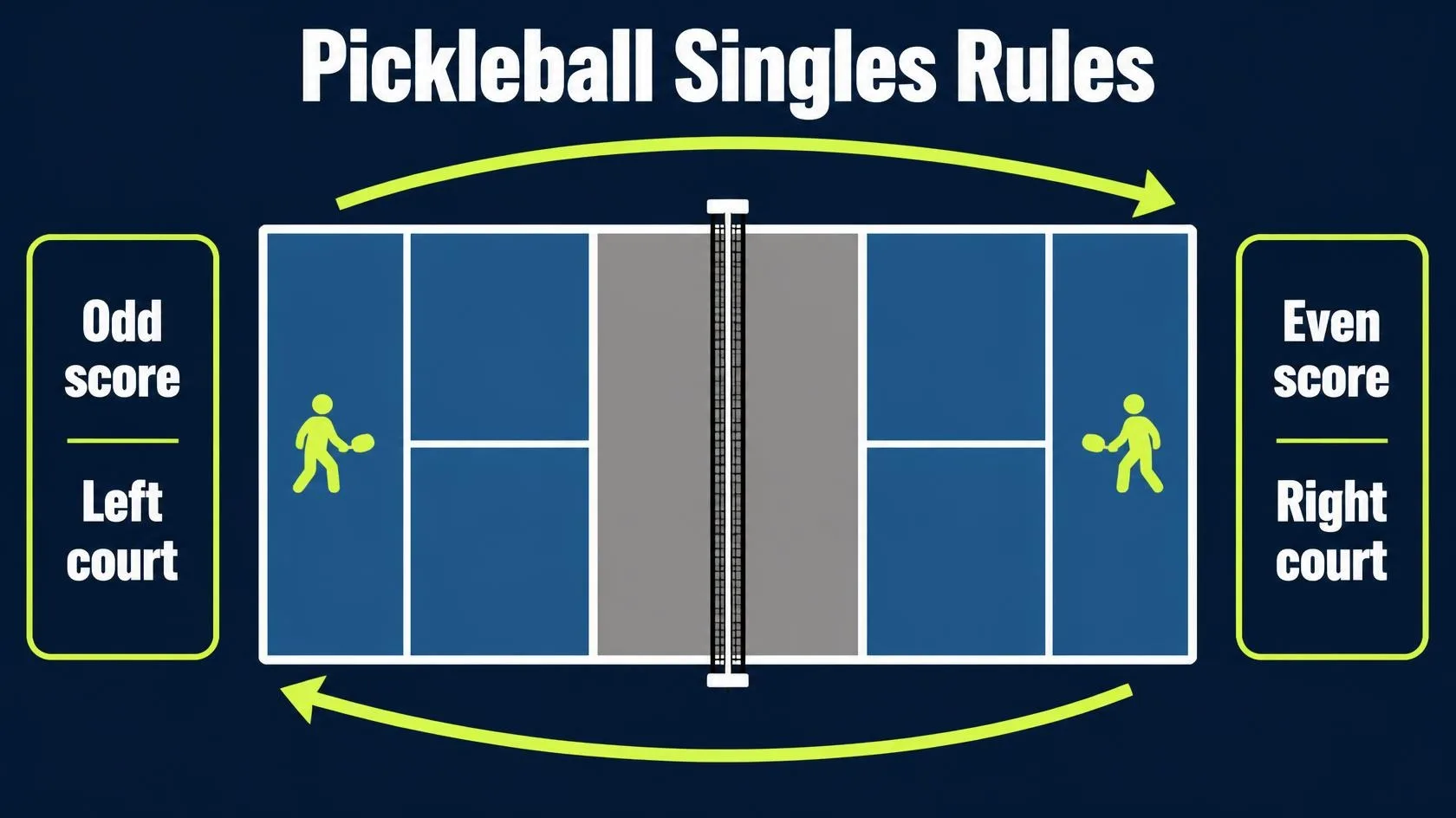
Under pickleball singles rules, positioning is set by the server’s score. This is Rule 5.A.1 in the official rulebook, in plain English:
- If the server’s score is even (0, 2, 4, 6, 8, 10), the serve is made from the right-hand serving area, and it must be received in the right-hand service court.
- If the server’s score is odd (1, 3, 5, 7, 9), the serve is made from the left-hand serving area, and it must be received in the left-hand service court.
The receiver mirrors this, standing diagonally opposite the server in the service court the score points to. If you are receiving and your opponent’s score is even, you set up in your right service court. If their score is odd, you set up in your left.
This gives you a built-in memory aid. If you lose track of the score mid-game, look at where everyone is standing. The positions rebuild the score for you. Serving from the right means the server’s score is even. Serving from the left means it is odd.
Because you alternate sides after every point you win, you will serve and receive from both the right and the left all game long. There is nowhere to hide a weak side.
Serving in singles: rotation and basics
Serving rotation under pickleball singles rules could not be simpler. One person serves until they lose a rally, then the serve changes hands. There is no server number, no partner waiting for a turn, and no special exception for the first serve of the game. The first server just serves, starting from the right side at 0-0.
The serve itself follows the same rules as doubles:
- Hit it underhand, paddle contacting the ball below your waist.
- Stand behind the baseline, with at least one foot on the ground behind the line and no foot touching the court or the baseline.
- Aim diagonally into the opposite service court, past the kitchen line. A serve that lands in the non-volley zone or on its line is short, and it is a fault.
- You get one serve attempt per rally. There is no second serve like tennis.
- The drop serve is legal in singles, just as it is in doubles. You can drop the ball and let it bounce before hitting your serve, as long as you do not toss it up or throw it down.
Serving is a whole topic on its own, including foot faults, the 10-second rule, and what changed in recent rule updates. Our full guide to pickleball serve rules covers all of it.
One singles-specific point: because only the server scores, your serve starts every point you can actually win. Treat it as an attacking shot, not a formality.
The two-bounce rule and the kitchen in singles
New players often ask whether the famous pickleball quirks change in singles. They do not.
Under pickleball singles rules, the two-bounce rule applies exactly as written. The serve must bounce before the receiver hits it. The return of serve must bounce before the server hits it. After those two bounces, either player can volley the ball out of the air.
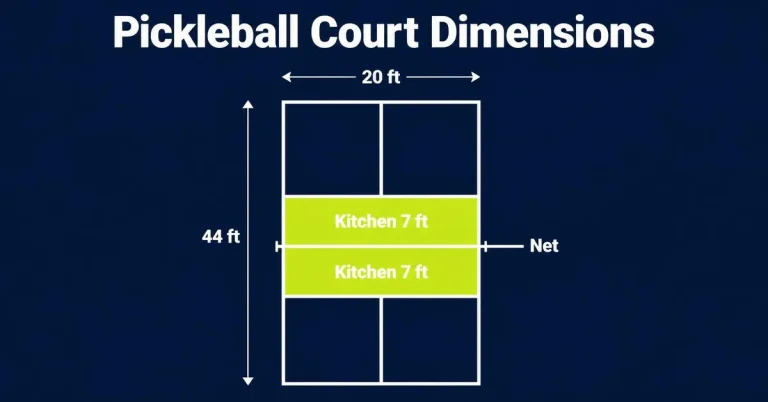
The non-volley zone, the 7-foot area on each side of the net that everyone calls the kitchen, works the same too. You cannot volley a ball while any part of your body is touching the kitchen or its line, and your momentum cannot carry you into it after a volley. You can stand in the kitchen between shots and hit any ball that bounces there. You just cannot take one out of the air while you are in it. Our kitchen rules guide explains the momentum rule and the common faults in detail.
What changes is the feel. In doubles, rallies usually end up at the kitchen line, with both teams dinking patiently. In singles, most rallies are won and lost from the baseline with passing shots. You will step up to the kitchen line when your opponent plays short, but you will rarely camp there.
The court itself does not change either. Singles uses the same 20 by 44 foot court as doubles, with the same lines and the same net height. Some pages claim singles uses a shorter 22-foot court. That is simply wrong, and it matters, because practicing on a shortened court throws off your depth judgment in real games. The full measurements are in our pickleball court dimensions guide.
Singles vs doubles: what actually changes
Here is the honest summary. The rulebook is nearly identical. The experience is not.
| Rule or feature | Singles | Doubles |
|---|---|---|
| Score call | Two numbers: server, receiver | Three numbers: team, team, server number |
| Servers per side out | One player serves until they lose a rally | Both partners serve before a side out, except the first turn of the game |
| Court size | Full court, 20 x 44 ft | Full court, 20 x 44 ft |
| Who can score | Only the server | Only the serving team |
| Serving side | Set by your own score, even right and odd left | Set by the team score plus server number |
| Two-bounce rule | Same | Same |
| Kitchen rules | Same | Same |
| Court coverage | One player covers everything | Shared with a partner |
| Typical rally style | Baseline rallies, passing shots | Kitchen line dink battles |
To see the doubles side of this table explained properly, including the three-number call and stacking, read our guide to pickleball doubles rules.
Skinny singles: the half-court game hiding in plain sight
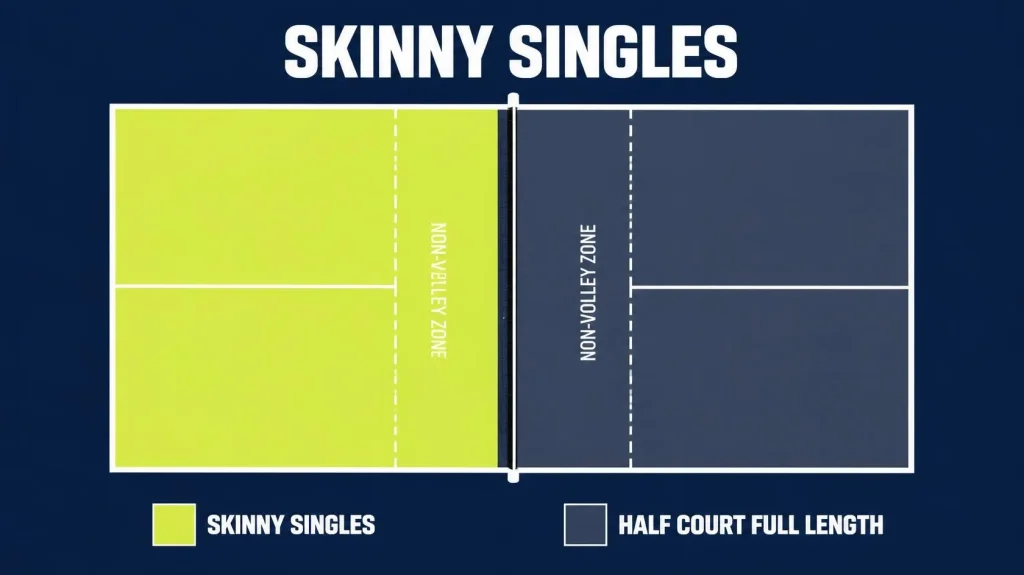
Here is the section you will not find in most singles guides. Skinny singles is a two-player format played on half the court, lengthwise. Only a 10-foot-wide lane is in play, and every shot has to land inside it.
Skinny singles began as a training format, but the 2026 rulebook made the half-court game official. It is now Rule 14.B, mini-singles: the lane in play follows each player’s own score, the unused half is out of bounds, and the centerline extends through each kitchen to mark the boundary. What follows matches the official version, and it has become the standard way for two players to get real singles reps.
Here is how the standard version works:
- Pick your lanes. In the most common setup, you play on diagonal halves. In the straight-ahead version, both players use the same side lane, handy for working on one pattern, like forehand to forehand.
- Your position follows your score, exactly as in full singles. Even score, you play from the right half. Odd score, you play from the left half.
- Serve diagonally into the service box inside the active half, following the normal serve rules and the two-bounce rule.
- After the serve, every shot must land in the active half. A ball that lands in the unused half is out, even if it lands inside the full court.
- Scoring is standard side-out scoring. Only the server scores, games go to 11, win by 2.
One detail makes the score-tracking version interesting. Each player’s position is set by their own score, so the geometry changes as the score changes. When both scores are the same type (both even, or both odd), you end up diagonal from each other and the point plays crosscourt. When one score is even and the other is odd, you line up straight across from each other and the point plays down the line in the 10-foot lane. You never settle into one comfortable pattern.
Why play it?
- The reps: rallies last longer and you hit far more balls per minute than in full-court singles.
- The feedback: a narrow target exposes loose direction control fast, and deep, accurate shots get rewarded right away.
- And the transfer: crosscourt dinking, deep returns, and patient point building are exactly the skills that carry into doubles, which is why so many doubles players drill this way.
A practical tip: agree on the format before the first serve, crosscourt only or the score-tracking version that mixes in down-the-line points. Both are common, and mixing them up mid-game causes arguments no rulebook can settle.
✓Pro tip: agree on the format before the first serve, crosscourt only or the score-tracking version that mixes in down-the-line points. Both are common, and mixing them up mid-game causes arguments no rulebook can settle.
Rally scoring: the variant you might run into
Most singles you will ever play uses side-out scoring. But you may walk into a league night or a pro-style event that uses rally scoring, so it is worth knowing how it differs.
In rally scoring, every rally produces a point. Win the rally and you score, whether you served or not. Games are usually played to 15 or 21 instead of 11, still win by 2 in most formats. Serving positions still follow the score, and the singles call stays at two numbers.
The format is best known from Major League Pickleball, whose games go to 21 with an extra twist: the winning point has to come on the leading team’s own serve. USA Pickleball has also made rally scoring a provisional option for certain tournament formats. It has not replaced side-out scoring, which still runs sanctioned events and everyday recreational play.
If you are invited to a rally scoring game, the adjustment is mental more than technical. Every rally counts, so there are no free errors as the receiver. Play a touch more conservatively than in a side-out game, especially late in a close one.
Beginner strategy that fits the rules
In pickleball singles rules, you do not need pro technique to win beginner singles. You need to understand what the rules reward.
- Serve deep. Aim within a couple of feet of the baseline. A deep serve keeps your opponent back and gives you a weaker, later return to work with.
- Return deep, then take a step or two in. The return has to bounce for the server anyway, so use that time. A deep return down the middle cuts off angles and gives you a neutral start.
- Move your opponent, not the ball past them. You rarely hit clean winners against someone your own level. Hit corner to corner, make them run, and wait for a short ball.
- Pass with purpose. When you come forward and your opponent is at the net, the passing shot or the lob are your two answers. Crosscourt passes have more room to land in. Down-the-line passes are riskier but catch net players leaning.
- Recover to the middle. After every shot, get back toward the center of the baseline. Singles points are lost by players admiring their last shot while the next one lands in the open court.
- Be patient late in games. Because nobody scores without the serve, long stretches at 9-9 and 10-10 are normal. The player who blinks first and forces shots usually loses.
Fitness helps, and there is no way around it. Singles is the most physical format in pickleball. Start with short sessions, build up, and mix in skinny singles when you want the workout with less ground to cover.
Frequently asked questions
How do you score in singles pickleball?
Under pickleball singles rules, only the server scores. Win a rally on your serve and you earn a point. Win a rally as the receiver and you earn only the serve, a side out. Games are played to 11 points and you must win by 2.
Which side do you serve from in singles?
Under pickleball singles rules, your own score decides. If your score is even, serve from the right side. If your score is odd, serve from the left side. You switch sides after each point you win, and the receiver sets up diagonally opposite you.
How many numbers are in a singles score call?
Two. You call the server’s score first and the receiver’s score second, like 7-5. The three-number call from doubles includes a server number; singles has none, with one player per side.
Is the singles court smaller than the doubles court?
No. Singles uses the exact same court as doubles: 20 feet wide by 44 feet long, with the same lines and net height. Any source telling you singles uses a shorter court has it wrong.
Is the kitchen rule the same in singles?
Yes. You cannot volley while touching the non-volley zone or its line, and momentum cannot carry you in after a volley. Groundstrokes and dinks from inside the kitchen are fine.
What is side-out scoring?
Side-out scoring means only the serving player or team can score points. When the server loses a rally, no point is awarded. The serve passes to the other side, and that handover is the side out. It is the traditional scoring system and the standard in the official rulebook.
Do you get a second serve in singles?
No. You get one serve attempt per rally. If you fault on the serve, the rally is over and, since you were serving, the serve passes to your opponent. There are no second serves in singles or doubles.
Can you use the drop serve in singles?
Yes. The drop serve is legal in singles. Drop the ball from one hand without tossing it up or forcing it down, let it bounce, then hit it underhand into the diagonal service court. It follows the same rules as the standard volley serve apart from the bounce.
What is skinny singles?
Skinny singles is a two-player format played on half the court, lengthwise, so only a 10-foot-wide lane is in play. Normal serving, scoring, and two-bounce rules apply, and your position follows your score. The 2026 rulebook recognizes it officially as mini-singles (Rule 14.B). It is popular because it produces longer rallies and more touches.
Can beginners start with singles?
Yes, and many coaches recommend it. Singles forces you to learn the full court, honest footwork, and deep serving and returning from day one. Just keep early sessions short: it is a much bigger physical workout than doubles.
Checked: October 25, 2026, against the 2026 USA Pickleball Official Rulebook
2 Comments