Padel vs Pickleball: 9 Key Differences to Know
Home > Guides > Padel vs Pickleball: 9 Key Differences to Know
Comparison
Padel vs pickleball is one of the most searched comparisons in racket sports, because the two games look similar at first glance: solid paddles, no strings, small courts, and a social doubles culture. They are not the same sport. Padel is played inside a glass-walled enclosure where the walls are part of the game, and pickleball is played on an open court where the walls do not exist. This guide compares the two side by side: courts, walls, paddles, balls, rules, and scoring, plus which sport fits you and how to switch.
✓Different sports, different courts. Padel uses an enclosed glass court, wall rebounds, tennis scoring, and almost always doubles. Pickleball uses an open court, no walls, a kitchen rule, and games to 11. In the United States, pickleball is far easier to find and play.
Padel vs pickleball at a glance
| Feature | Padel | Pickleball |
|---|---|---|
| Court | 20m x 10m, enclosed | 13.41m x 6.09m, open |
| Walls | Glass and mesh walls, ball stays live off rebounds | None in play |
| Players | Almost always doubles | Singles or doubles |
| Racket or paddle | Perforated, no strings, up to 45.5cm, wrist cord required | Solid, smooth, no holes |
| Ball | Pressurised rubber, 6.35-6.77cm, lower bounce than tennis | Lightweight plastic with holes |
| Serve | Underarm, after the ball bounces, two attempts | Underarm, contact not above the waist, one attempt |
| Scoring | Tennis scoring, best of 3 sets | Games to 11, win by 2 |
| Signature rule | Wall rebounds stay in play | No volleying inside the kitchen |
| Origin | Acapulco, Mexico, 1969 | Bainbridge Island, USA, 1965 |
The court and the walls
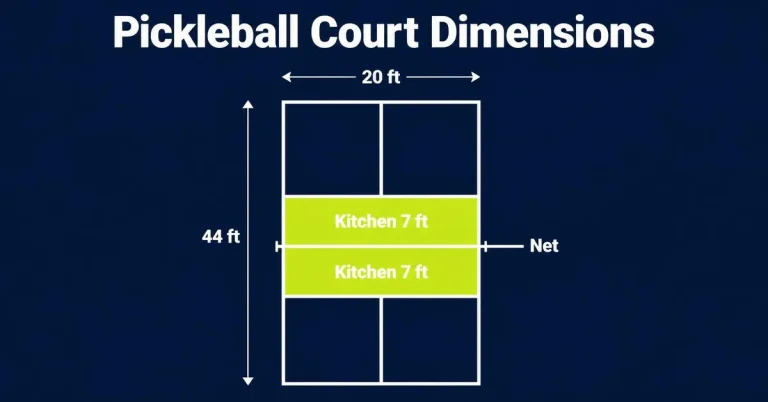
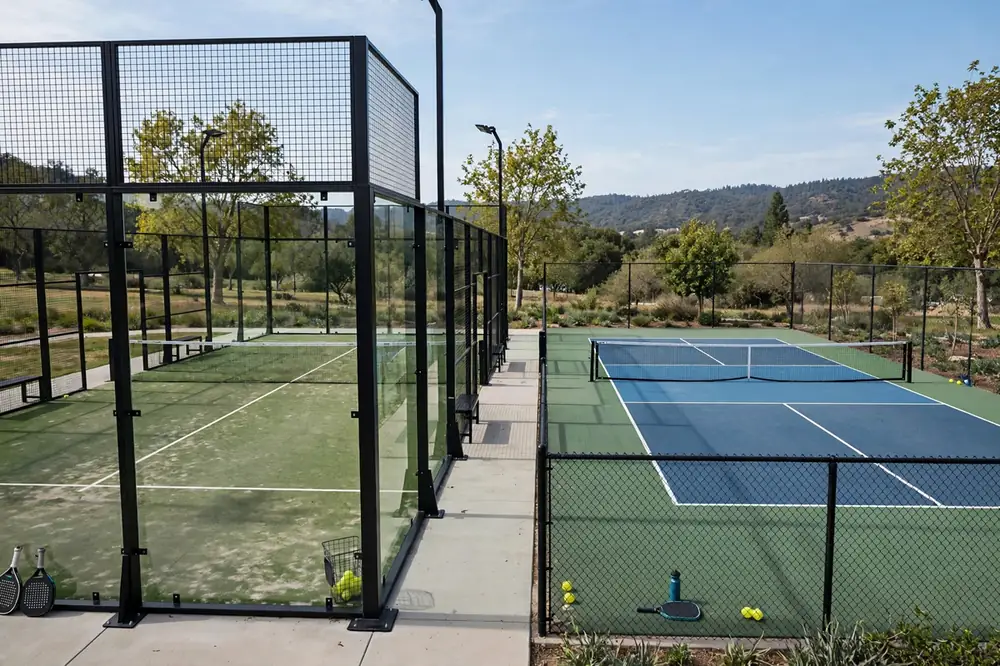
The walls are the big difference between padel and pickleball. A padel court is a rectangle measuring 65.6 feet by 32.8 feet (20m by 10m), fully enclosed by glass and metal mesh walls. The ball can be played off the glass after it bounces, and wall play is central to padel strategy: players lob into the back corner and angle shots off the wall on purpose. A pickleball court is much smaller at 44 feet by 20 feet, and it is the same size for both singles and doubles. There are no walls in play, and a ball that leaves the court is dead. The full measurements are in the court dimensions guide.
Access is pickleball’s biggest advantage in the United States. Up to four pickleball courts fit on one tennis court, and you can play on a tennis court by lowering the net and marking lines. Padel needs its own purpose-built enclosure, so you can only play where a venue has built one, and padel courts are still far less common in the US than pickleball courts.
Rackets, paddles, and balls
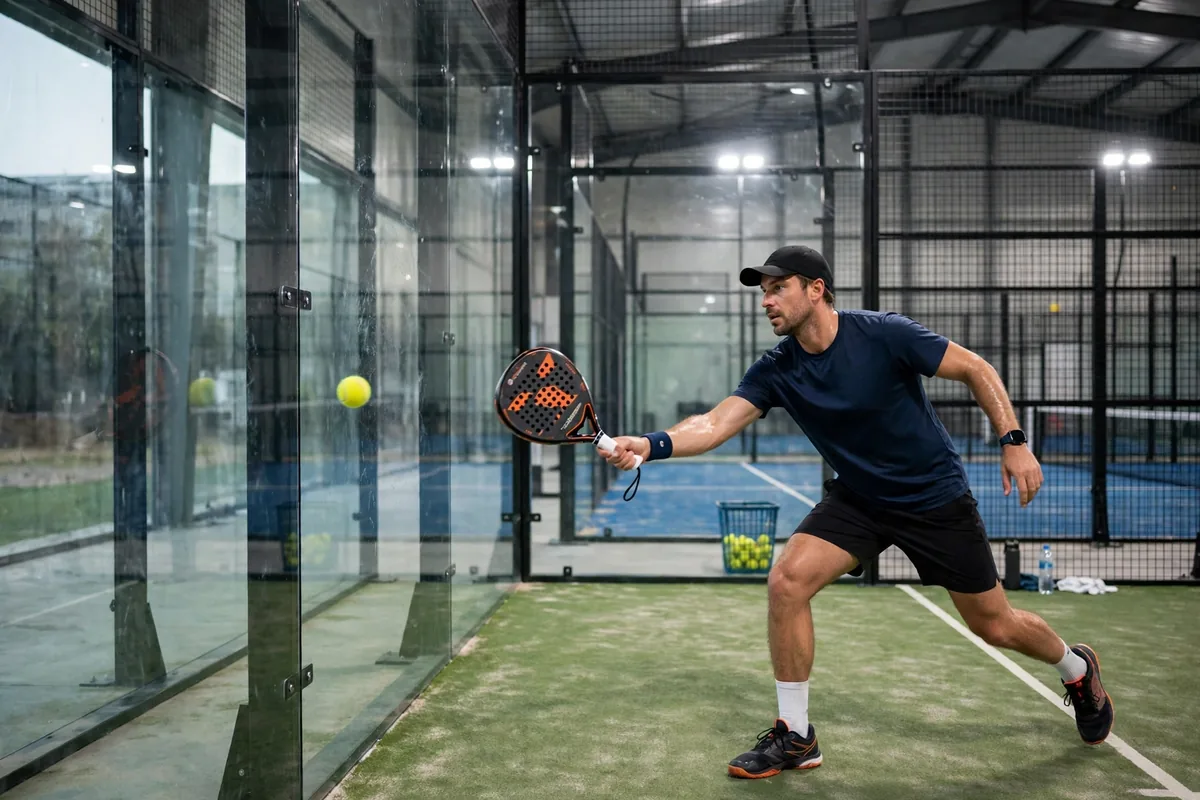
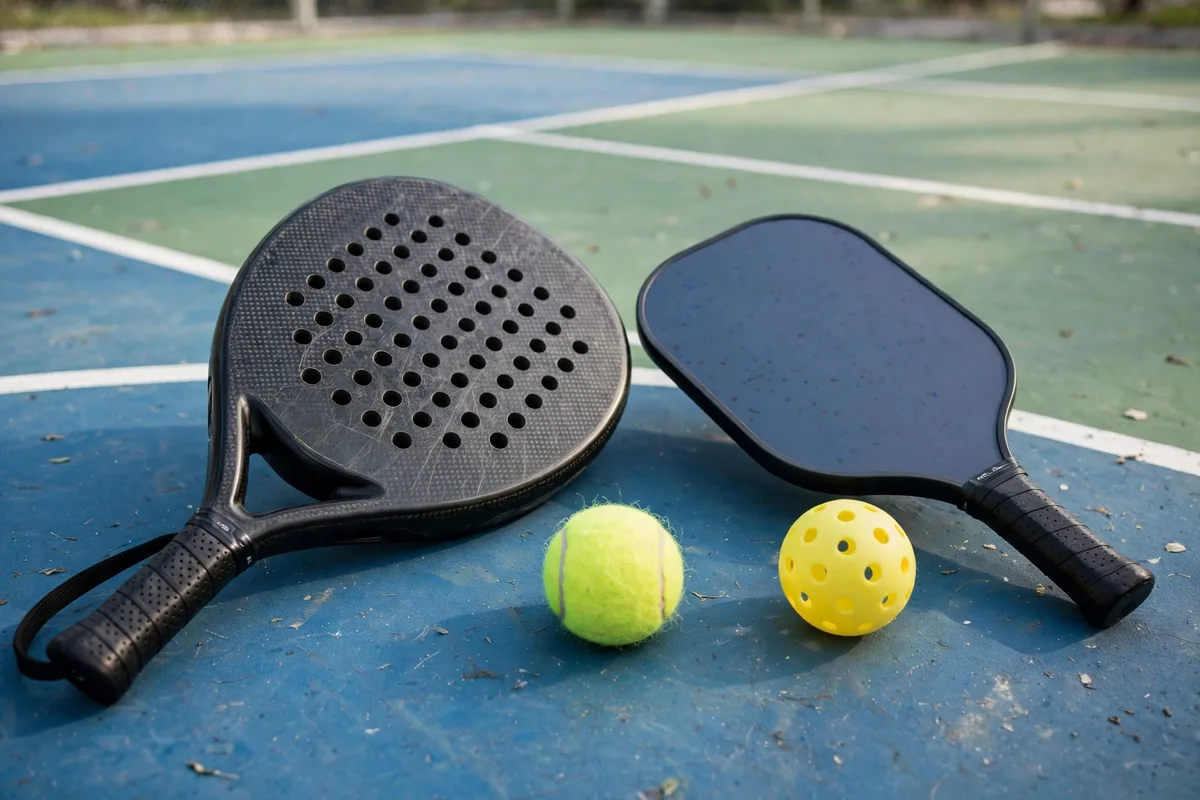
A padel racket is solid and perforated, with no strings, up to 45.5cm long, and a wrist cord is required. Most weigh between 340 and 390 grams. A pickleball paddle is also solid and stringless, but it is not perforated and its hitting surface must be smooth. The rules cap the combined length and width at 24 inches, with the length alone no more than 17 inches, and most paddles sit between 6.5 and 14 ounces. The balls are different too. Padel uses a pressurized rubber ball that looks like a tennis ball but has slightly lower pressure, which gives it a lower bounce and helps players keep pace with rebounds off the glass. Pickleball uses a lightweight plastic ball with holes drilled through it: the balls have between 26 and 40 holes and must be a single solid color. The balls guide explains the hole counts and indoor versus outdoor differences.
Rules compared
Padel is designed to be played as doubles, with two players on each side. Pickleball can be played as either singles or doubles, though doubles is the most common format. Both sports begin with an underhand serve struck diagonally into the opponent’s service box, and in both the ball can only bounce once per side. The serve differs in detail. In padel, the serve is underarm, struck after the ball bounces, and the server gets two attempts. In pickleball, the serve is underarm with contact not above the waist, and the server gets one attempt. The signature rules are opposites. In padel, your shot must bounce on the opponent’s side before hitting the wall, and then the wall keeps the ball live. In pickleball, there must be one shot on either side of the net, including the serve, before you can play a volley, and you must be outside the kitchen to volley at all. The kitchen is the non-volley zone near the net, and the kitchen rules explain it in full.
For the official pickleball rules, USA Pickleball publishes the rulebook.
Scoring compared
Padel uses tennis scoring: points run 15, 30, 40, and deuce, games build into sets, and matches are most commonly best of three sets. To win a set you must win six games and lead by two clear games. Pickleball scoring is simpler: games are commonly played to 11 points, win by two, and only the serving side scores in standard side-out scoring. The scoring guide covers the full system.
For a beginner, pickleball scoring is easier to follow in the first session. Tennis scoring is familiar to anyone who has watched tennis, but it takes longer to learn the set structure.
Which should you play?
Pick pickleball if you want the easiest start. Courts are everywhere in the United States, the ball is slower, the rules are simpler, and you can play singles or doubles. It is the better choice for a first racket sport, for older players, and for anyone who wants a game they can find near home. Pick padel if you want a faster, more athletic game and you live near a padel venue. The walls add a layer of strategy that takes real time to learn, rallies last longer, and the sport asks more of your legs and lungs. Padel is huge in Spain and Latin America and still growing in the United States, so check access before you commit. If you are a tennis player, both are easy to try. Pickleball lets you convert a tennis court with lines and a lowered net, and the conversion guide shows the setup.
Switching between the two
You cannot swap the equipment. A padel racket is smaller, heavier, and perforated, and it does not work as a pickleball paddle. A pickleball paddle is larger and lighter, and it is not built for padel’s glass-wall rebounds. Buy the right racket for the sport you play. Skills do transfer. Positioning, anticipation, and soft touch help in both games. A pickleball player moving to padel must learn wall play and tennis scoring. A padel player moving to pickleball must learn the kitchen rule and the two-bounce rule, and slow down: the plastic ball dies much faster than a padel ball.
Padel vs pickleball questions, answered
Is padel the same as pickleball?
No. Both use solid paddles on compact courts, but they are different sports with different courts, balls, rules, and strategies. Padel uses glass walls and a tennis-style ball; pickleball uses an open court and a plastic ball with holes.
Is padel harder than pickleball?
For a complete beginner, yes. Pickleball has a lower learning curve: the slower ball and simpler rules make it easier to enjoy from the first session. Padel asks more athleticism and takes longer to learn because of wall play and tennis scoring.
Can I use a padel racket to play pickleball?
No. The equipment is different: padel rackets are smaller and heavier and perforated, while pickleball paddles are larger, lighter, and smooth. Each sport needs its own racket.
Which is more popular in the United States?
Pickleball, by a wide margin. Pickleball courts are everywhere in the US, while padel is still growing here despite its size in Spain and Latin America. If access matters, pickleball wins.
Is paddle tennis the same as pickleball?
No, and it is not the same as padel either. Paddle tennis is a third, older sport, played with a solid paddle on a smaller tennis-like court. The names get mixed up in searches, which is why the difference between paddle tennis and pickleball confuses so many people.
Related guides
Checked: November 2, 2026, against official governing-body figures and published comparisons.