
Pickleball Terms: 40 Words Every Player Should Know
Pickleball terms can sound strange the first time you hear them. Kitchen, dink, erne, ATP: every one of them means something specific on court. This glossary explains 40 pickleball terms in plain words, grouped by court, scoring, shots, and slang, so you can follow any game or conversation.
Start with five: kitchen, dink, side out, two-bounce rule, and third shot drop. Learn those and most of what you hear on court will make sense.
Court words
| Term | What it means |
|---|---|
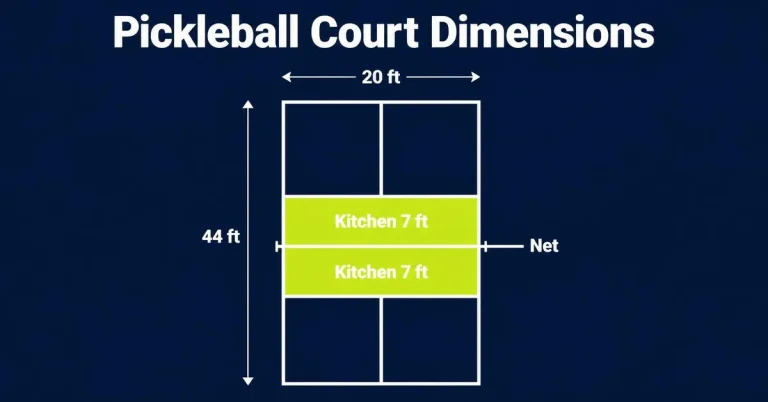
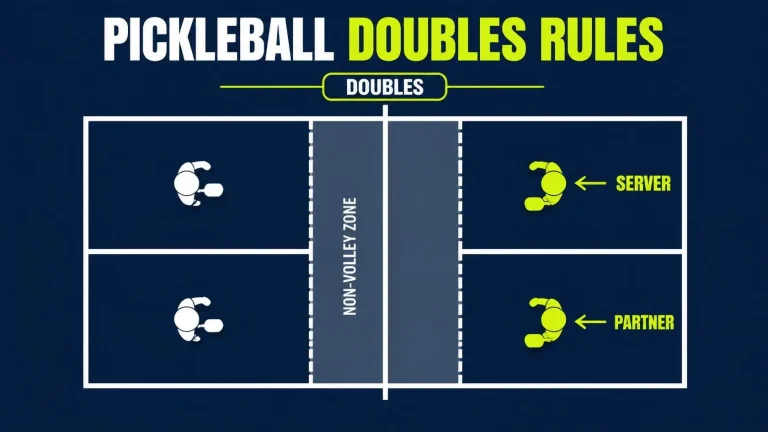
| Kitchen (non-volley zone) | The 7-foot zone on both sides of the net. You can stand in it any time, but you cannot hit a volley while touching it or its lines. |
| Baseline | The back line of the court. Serves start from behind it. |
| Sideline | The lines that mark the sides of the court. Doubles uses the outer sidelines, singles uses the inner ones. |
| Centerline | The line down the middle that splits the service boxes into left and right. |
| Service box | The two boxes on each side of the net, split by the centerline, where a legal serve must land. |
| Transition zone | The strip between the baseline and the kitchen line, also called no man’s land. The hardest place to play from, since you can be attacked at your feet. |
The kitchen rules guide covers the zone and its faults in full.
Scoring and sequence words
| Term | What it means |
|---|---|
| Side out | When the serve passes to the other team. |
| Rally | The exchange of shots from the serve until the rally ends. |
| Fault | Any rules violation that ends the rally, like a serve into the net or a ball hit out. |
| Dead ball | A ball that is no longer in play after a fault or the end of a rally. |
| Two-bounce rule | The serve must bounce once, and the return must bounce once, before anyone can volley. |
| Score call | The score announced before each serve. In doubles, three numbers. In singles, two. |
| Let | A serve that clips the net and still lands in the correct service box. There are no let replays in pickleball, so the ball stays live. |
For the full system, read the pickleball scoring guide.
Shot words
| Term | What it means |
|---|---|
| Serve | The underhand shot that starts every rally, hit from behind the baseline into the diagonal service box. |
| Return of serve | The first shot by the receiving team. It must bounce before the serving team plays the next shot. |
| Volley | Any shot hit in the air before the ball bounces. |
| Groundstroke | Any shot hit after the ball bounces. |
| Dink | A soft shot from near the kitchen line that arcs just over the net and lands in the opponent’s kitchen. |
| Third shot drop | The serving team’s third shot of the rally, hit softly so it lands in the kitchen and lets the serving team move to the net. |
| Third shot drive | The hard, flat alternative to the drop: a fast third shot meant to force a weak reply. |
| Lob | A high, deep shot over opponents at the net, usually to buy time or push them back. |
| Overhead (smash) | A hard downward shot, usually to finish a lob that sits up too high. |
| Drive | A hard, flat shot hit with pace, often from the baseline or midcourt. |
| Reset | A soft, controlled shot that takes pace off a hard ball and drops it back into the kitchen. |
| Speed-up | A sudden hard volley from the kitchen line, meant to break a dink exchange. |
The dink has its own full guide, with the shot’s shape and purpose.
Advanced and slang words
| Term | What it means |
|---|---|
| Erne | A volley hit from beside the kitchen, or by jumping across its corner, without touching the zone. Named after Erne Perry. |
| Bert | An erne played in front of your partner’s side of the court. |
| ATP (around the post) | A shot hit around the outside of the net post instead of over the net. It is legal, and it does not need to clear the net. |
| Poach | Crossing into your partner’s side to take a ball you can hit better. |
| Stacking | A doubles formation where partners line up so each stays on a preferred side, usually to keep a forehand in the middle. |
| Shake and bake | A doubles play where one partner drives the third shot and the other rushes the net to finish the reply. |
| Nasty Nelson | A serve deliberately hit at the opponent standing at the net, the non-receiver. Legal, and unpopular. |
| Pickled | Losing a game 11-0. |
| Banger | A player who hits almost every shot as hard as possible, with little soft play. |
| Tweener | A shot hit between the legs, usually while running back to chase a lob. |
| Falafel | A shot with almost no pace, barely clearing the net. |
| Skinny singles | Singles played on only half the court, using one service box per side. |
| Ace | A serve the receiver cannot touch at all. |
| Dillball | A ball that has bounced once and is still live. |
| Flapjack | A shot that must bounce before it is hit. |
USA Pickleball publishes the official rulebook, which is the final word when a term is disputed.
Pickleball terms questions, answered
What is the kitchen in pickleball?
The non-volley zone: the 7-foot area on both sides of the net. You can stand in it any time, but you cannot hit a volley while touching it or its lines.
What is a dink in pickleball?
A soft shot from near the kitchen line that arcs just over the net and lands in the opponent’s kitchen. It is the shot that defines patient, high-level play.
What is an erne in pickleball?
A volley hit from beside the kitchen, or by jumping across its corner, without touching the zone. It is named after Erne Perry.
What does ATP mean in pickleball?
Around the post: a shot hit around the outside of the net post instead of over the net. It is fully legal.
What does it mean to get pickled?
To lose a game 11-0.
Related guides
Checked: October 27, 2026, against the USA Pickleball official rules and published pickleball glossaries.
One Comment