Stacking in Pickleball: How It Works and When to Use It

Stacking in pickleball is a doubles positioning tactic that lets partners play their preferred sides no matter what the score says. This tactic goes by several names: stacking pickleball, pickleball stacking, or simply stacking. The idea is simple: both players briefly line up on the same side of the court before a serve or return, then slide to their preferred sides while the ball is in flight. This guide explains how stacking works on the serve and the return, the rules that still bind you, full versus half stacking, and when your team should stack, and when it should not.
What is stacking in pickleball?
Stacking is a doubles positioning system that helps partners return to preferred left- and right-side roles without changing who must legally serve or receive. In traditional positioning, each partner stands on their own side: the server behind the baseline on the correct side, the partner at the kitchen line on the opposite side. With stacking, both players start on the same side, then move to their target sides after the ball is struck.
The driving reason is almost always forehands in the middle. Most shots in doubles go through the middle of the court, so teams want their stronger forehand covering it. If your team’s forehand-dominant player normally plays the left side, stacking lets them play the left side on every point, even when the score would otherwise force them to the right.
Lefty-righty pairs are the exception that proves the rule. A left-handed player on the right side and a right-handed player on the left side already have both forehands in the middle without stacking, which is why lefty-righty teams often stack less. Stacking is a tool for righty-righty pairs to get the same advantage.
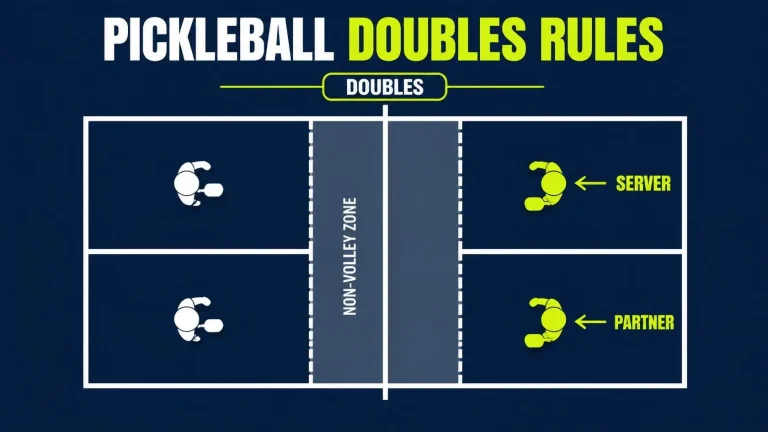
Doubles is the only format where stacking applies, and the doubles rules explain the standard positioning it replaces.
Is stacking legal?
Yes. Stacking is legal under USA Pickleball rules, because the rules do not require doubles partners to stand in fixed left- and right-side positions throughout the rally. What the rules do require is that the correct player serves, the correct player receives, and the serve begins from and lands in the correct service courts. The stack can change where you wait and where you move. It cannot change who is required to serve or receive.
The rules that still bind a stacking team are: the correct server must serve from the correct service court, the serve must travel diagonally and land in the correct opposite service court, the correct receiver must return the serve, the receiving team must let the serve bounce before returning it, and the serving team must let the return bounce before playing the third shot. For the official language, USA Pickleball publishes the rulebook.
One more rule matters on the return side: the non-returner cannot be inside the non-volley zone before the ball bounces. They can stand at the kitchen line, just not in the kitchen.
How stacking works on the serve
- The server takes the correct position for the score: right side for even scores, left side for odd.
- The partner lines up beside the server. There is no rule about where the non-server stands before the serve, as long as they stay on their own side of the net, so just outside the sideline is fine.
- The server hits the serve, then immediately moves toward their preferred side.
- The partner also moves toward their preferred side as the ball travels to the receiving team.
- Both players are in their optimal positions before the return comes back.
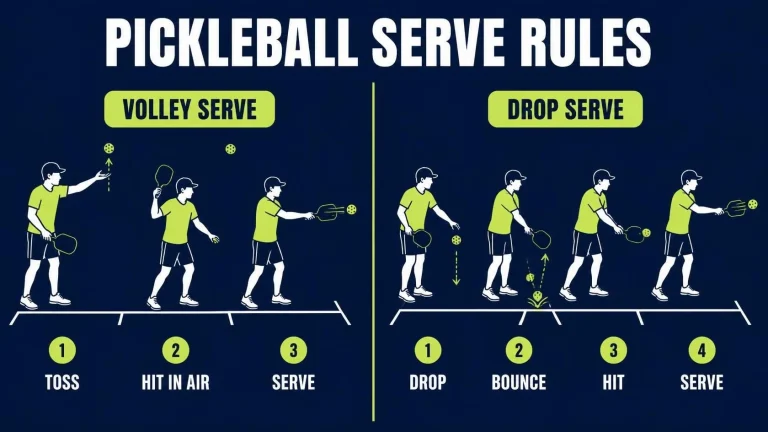
The most common configuration: the stronger or more forehand-dominant player wants the left side. If the score forces that player to serve from the right, they serve from the right, then slide left as the ball travels. Their partner, who started stacked beside them, slides right to take the vacated spot. The serve rules cover the legal serve itself in full.

How stacking works on the return
- The returner stands in the correct receiving position for the score.
- The non-returner lines up just outside the sideline, or near the kitchen line on the intended final side.
- The returner hits the return, then immediately moves to their preferred side.
- The non-returner advances to the kitchen line on their side.
The return is simpler in some ways and harder in others. It is simpler because the returner has to be in a real position to actually hit the ball: you cannot fake the return. It is harder because the returner must cross the court after hitting, under time pressure. Remember the kitchen rule from the legality section: the non-returner can wait at the kitchen line but cannot stand inside the kitchen before the ball bounces. The kitchen rules explain the non-volley zone in full.
Full stack vs half stack vs 3/4 stack
| Version | What you do | Best for |
|---|---|---|
| Full stack | Stack on every point, both serving and returning | Experienced pairs who want the advantage on every point |
| Half stack | Stack only on the serve, or only on the return | Beginners: serve-side half stack is the standard starting point |
| 3/4 stack | Stack most of the time but skip it when the move is too far | Less agile partners who cannot cover the slide every point |
Full stacking maximizes the advantage but requires precise coordination, and it is easy to get caught mid-transition while you are learning. Half stacking is the recommended start: stack for serving rather than serving and receiving, which gives you optimal positions whenever you serve while keeping things simple. Stacking when receiving is more challenging, because it is easier to make mistakes with the service order and tougher to make the run to the open area after the return.
When to stack, and when not to
Stack when your team has a clear forehand advantage to protect: a dominant forehand player who should own the middle, a weak backhand that opponents keep targeting, or a left-side player whose forehand wins points. Stack when both partners communicate well and move comfortably, because stacking punishes slow feet. Do not stack when communication is weak, when either partner is slow getting to position, or when opponents have already worked out that your open court is undefended during the slide and keep hitting there. Do not stack on every point just because you can: if the score already puts both players on their preferred sides, no stack is needed at all. The strategy guide covers positioning and tactics that pair with stacking, especially covering the middle.
Signals: how partners call switch or stay
Stacking fails without communication, so teams agree signals before the point. The common system is hand signals behind the back: an open hand means switch, a closed fist means stay. Verbal calls work too: say “switch” or “stay” before the serve or return so both partners move on the same plan. Agree the signal, make the call before the point starts, and abandon the rotation whenever it prevents either player from becoming balanced before the opponent contacts the ball.

Common stacking mistakes
- Serving or receiving from the wrong side. Stacking never changes who must serve or receive, and hitting from the wrong side is a fault.
- Forgetting the score. The score decides the correct court, so track it before every point, especially after long rallies.
- Getting caught mid-transition. If you are still sliding when the return arrives, you are out of position. Shorten the slide or drop to a half stack.
- Standing in the kitchen early. The non-returner cannot be inside the non-volley zone before the ball bounces.
- Stacking when it is not needed. On scores that already put both players on their preferred sides, standard positioning is faster and safer.
A simple drill to practice stacking
Play a 10-point game where your team uses a serve-side half stack only. Before each serve, the server calls “switch” or “stay” out loud. After the point, freeze and check: are both players on their preferred sides, and did the correct player serve? Repeat until the calls and slides feel automatic, then add return-side stacking in the next session. Ten focused points teach more than a full match of confused stacking.
Stacking in pickleball questions, answered
What is stacking pickleball?
Stacking pickleball is a doubles positioning tactic where both players start on the same side of the court before a serve or return, then shift to their preferred positions after the ball is hit. It keeps forehands in the middle and preferred sides under every score.
Is stacking legal in pickleball?
Yes, under USA Pickleball rules. The rules only restrict who serves and receives and from which courts. Partners may stand anywhere on their own side before the serve or return, as long as the correct player plays the ball from the required court.
What is half stacking?
Half stacking means you stack only on the serve or only on the return, not both. Serve-side half stacking is the standard starting point for beginners, because it is simpler than stacking every point.
Does stacking work for lefty-righty pairs?
It can, but they need it less. A left-handed player on the right and a right-handed player on the left already have both forehands in the middle without stacking, so lefty-righty teams often stack only for specific matchups.
Is stacking the same as paddle stacking at open play?
No. Paddle stacking at open play is the queue system that decides who plays next. Stacking in a match is a doubles formation used during a game, and the two have nothing to do with each other.
Related guides
Checked: November 4, 2026, against published stacking guides and the USA Pickleball rulebook.