
Pickleball Court Dimensions: Exact Measurements and Layout
If you are taping lines on a driveway, converting a tennis court, or pricing out a backyard build, you need the real numbers, not guesses. Pickleball court dimensions are set by USA Pickleball and they are the same everywhere, indoors and out, for singles and doubles. That consistency is part of why the sport travels so well.
This page gives you every official court measurement in feet and meters, the rule number behind each one, and the practical stuff most guides skip: space around the lines, surfaces, costs, and how to lay a court out.
Quick answer
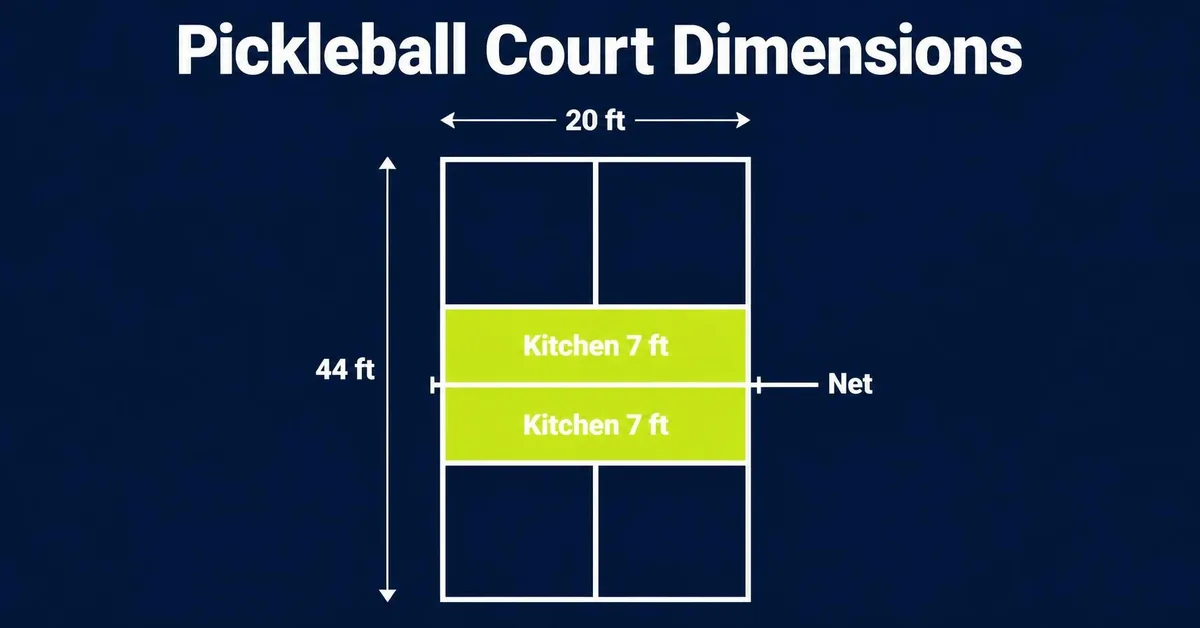
A regulation pickleball court is 20 feet wide by 44 feet long (6.10 m by 13.41 m). The kitchen runs 7 feet back from the net on each side. The net is 36 inches high at the sidelines and 34 inches high in the center. For the court plus room to move, plan on at least 30 by 60 feet of total space.
All the measurements in one table
| Part of the court | Feet and inches | Meters | Rulebook |
|---|---|---|---|
| Court, width by length | 20 x 44 ft | 6.10 x 13.41 m | Rule 3.A.1 |
| Court area | 880 sq ft | 81.7 sq m | Calculated |
| Kitchen (non-volley zone), each side | 7 x 20 ft | 2.13 x 6.10 m | Rule 3.A.4 |
| Service court, 4 total | 10 x 15 ft | 3.05 x 4.57 m | Rule 3.A.4 |
| Line width | 2 in | 5.08 cm | Rule 3.A.4 |
| Net height at the sidelines | 36 in | 91.44 cm | Rule 3.B.6 |
| Net height at the center | 34 in | 86.36 cm | Rule 3.B.7 |
| Net posts, inside to inside | 22 ft | 6.71 m | Rule 3.B.2 |
| Net length, minimum | 21 ft 9 in | 6.63 m | Section 3.B |
| Net depth, minimum | 30 in | 76.2 cm | Section 3.B |
| Minimum playing surface | 30 x 60 ft | 9.14 x 18.29 m | Rule 3.A.3 |
| Recommended for new courts | 34 x 64 ft | 10.36 x 19.51 m | Rule 3.A.3 |
What are the official pickleball court dimensions?
The playing court is a rectangle 20 feet wide and 44 feet long. That is Rule 3.A.1 in the USA Pickleball Official Rulebook, and it applies to both singles and doubles. Tennis changes its lines between singles and doubles. Pickleball does not. Those measurements run to the outside edge of the lines (Rule 3.A.2), so the 2-inch lines are part of the court, not extra. A ball that touches any part of a line is in, with one exception covered in the kitchen section below.
20 by 44 feet is also the size of a doubles badminton court. Pickleball borrowed that footprint back in 1965, which is one reason so many gyms could adopt the sport without repainting much.
Every line on the court, explained one by one
A pickleball court has five kinds of lines. Here is what each one does.
Baselines
The baselines are the back lines, one at each end, 22 feet from the net. You serve from behind the baseline, and a ball that lands past it is out.
Sidelines
The sidelines run the full 44-foot length of the court, 10 feet to each side of the center. In singles, the sidelines stay exactly where they are, which is why singles feels so tiring. You are covering the same 20-foot width alone.
Centerline
The centerline runs from the kitchen line to the baseline on each side, splitting the back part of the court into two service courts. It is 15 feet long on each side. A serve has to land in the service court diagonal from the server, and the centerline counts as part of both service courts it touches.
Non-volley zone lines
The kitchen line sits 7 feet from the net on each side. Two more lines close off the zone along the sidelines.
Service courts
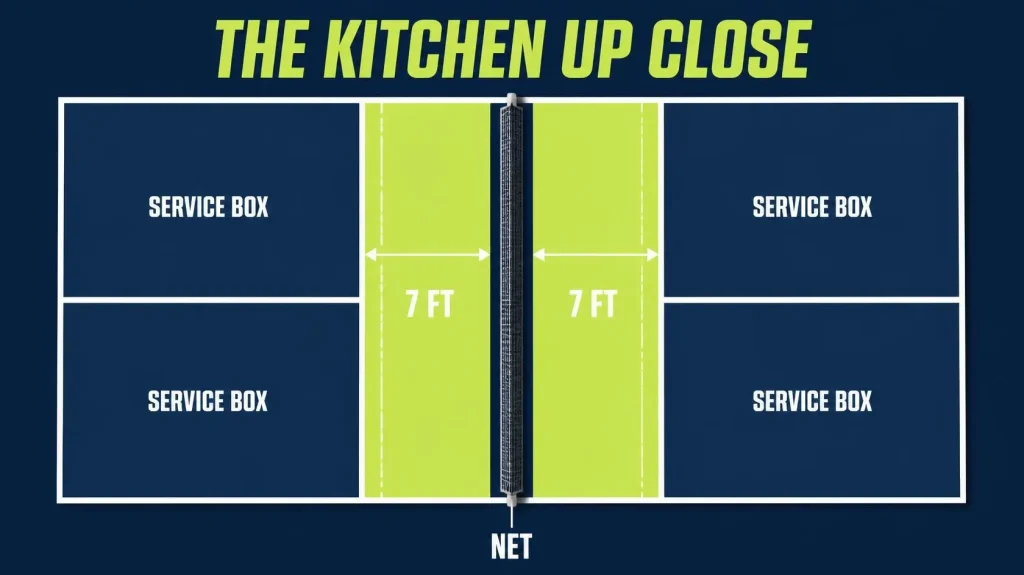
Each side of the court has two service courts, and each one measures 10 feet wide by 15 feet deep. The court is 20 feet wide, split in half by the centerline, and the area from the kitchen line to the baseline is 15 feet deep (22 feet from net to baseline, minus the 7-foot kitchen). Your serve has to clear the kitchen and land in the diagonal box, and the pickleball serve rules trip up plenty of new players on exactly this.
Add it all up and a court carries about 198 feet of lines. Useful if you are buying tape: two standard rolls usually cover a full court with some to spare.
How tall is a pickleball net?
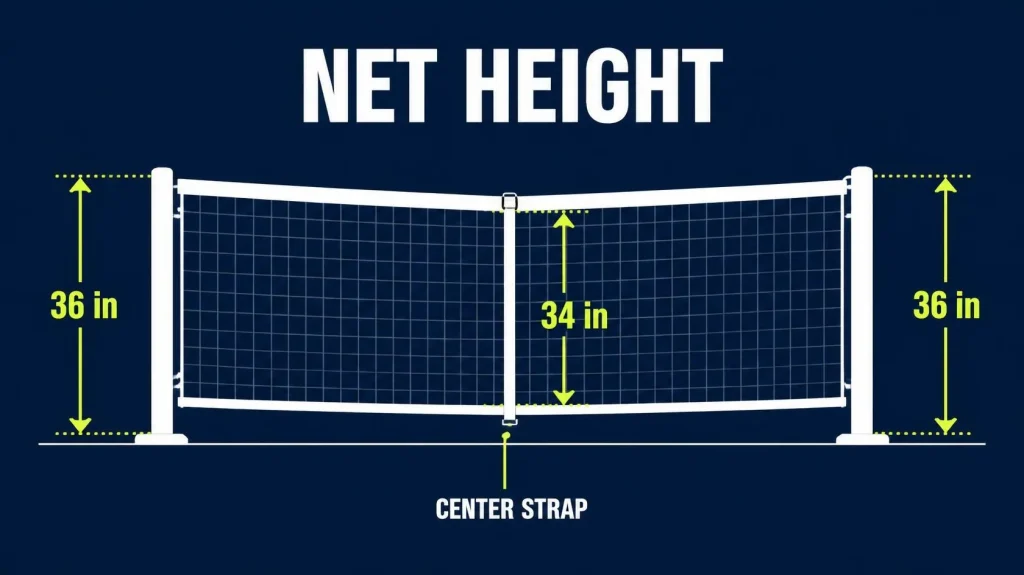
The net is 36 inches high where it meets the sidelines and 34 inches high at the center (Rules 3.B.6 and 3.B.7). That 2-inch dip in the middle is not sag or wear. It is built into the rules, and a center strap holds the net down at exactly 34 inches. Shots down the middle get a slightly lower net to clear, which is why middle balls are such a big part of the game.
The net posts stand 22 feet apart, measured inside to inside, which puts each post 12 inches outside its sideline.
- Posts can be no more than 3 inches in diameter.
- The net itself must be at least 21 feet 9 inches long and 30 inches deep, with a mesh small enough that a ball cannot pass through.
Pro tip: Quick check if you are setting up a portable net: measure the height at both ends and in the middle before the first serve. Portable systems drift, and an inch too high at the center changes every dink battle.
How big is the kitchen?
The non-volley zone, which everyone calls the kitchen, is the 7-foot strip on each side of the net, running the full 20-foot width of the court. The kitchen line itself is part of the zone. Step on the line while you volley and it is a fault.
Seven feet sounds generous until you play. The zone is deep enough that you cannot camp at the net and smash everything, which is the whole point. It forces the soft game: dinks, drops, and patience. What you can and cannot do inside those kitchen dimensions fills a whole rulebook section, so we covered it separately in our guide to the pickleball kitchen rules.
One measurement worth memorizing for serving: from the baseline to the far edge of the kitchen is 29 feet (22 feet to the net, plus 7 feet of kitchen). A legal serve has to carry at least that far and land in a service court that ends 15 feet past the kitchen line.
How much space do you need around the court?
The 20 by 44 foot rectangle is only the lined area. You also need room to run back for lobs, sidestep wide balls, and stop without hitting a fence. Rule 3.A.3 sets the minimum playing surface at 30 by 60 feet. That gives you 5 feet beside each sideline and 8 feet behind each baseline. Playable, but tight.
For new courts and tournaments, the rulebook recommends 34 by 64 feet. You can chase a deep lob without pulling up early, and referees and spectators get space that is not in the line of play.
A few more numbers that come up often:
- Wheelchair play: the recommended playing surface grows to 44 by 74 feet, so players have room to maneuver and turn.
- Stadium courts at big events: up to 50 by 80 feet, mostly for officials, cameras, and crowd space.
- Multiple courts side by side: keep at least 10 feet between sidelines, or hang divider nets, so balls stop wandering into the next game.
Does your space fit? A double driveway is often 20 to 24 feet wide, so the lines fit but the sideline runoff is thin. Fine for practice and family games, and thousands of people play exactly that way. A backyard build should aim for the full 30 by 60 if the lot allows it. A half basketball court fits the lines lengthwise but the runback gets squeezed, so expect to pull up short on lobs.
How do you lay out a court step by step?
- Mark the four corners of a 20 by 44 foot rectangle.
- Measure both diagonals. They should match at 48 feet 4 inches each. If the diagonals differ, your rectangle is a parallelogram and every line after it will be off. Adjust the corners until the diagonals agree.
- Run the baselines and sidelines, and mark lines 2 inches wide.
- Find the center and set the net line. Measure 7 feet out from the net on both sides and mark the kitchen lines across the full width.
- From each kitchen line, run a centerline 15 feet back to the baseline.
- Set the net posts 22 feet apart, 12 inches outside each sideline. Hang the net, strap the center down, and check: 36 inches at the sides, 34 in the middle.
Most people finish a taped court in under an hour once the corners are square.
Indoor vs outdoor courts: what changes and what does not
The court itself does not change. The rulebook gives one set of measurements, and indoor courts use the same 20 by 44 feet, the same kitchen, and the same net heights. What changes is everything around the lines.
Indoors, ceiling height is the big one.
- You need at least 18 feet for lobs to work, and 20 feet or more is better. Low gym ceilings turn every defensive lob into a coin flip.
- Lighting matters too: even, indirect light beats a single bright bank that blinds you on high balls.
Outdoors, orientation is the detail people forget.
- Run the court north to south so the sun stays to the side during morning and late afternoon play, instead of sitting in one player’s eyes at the baseline.
- And give the surface a slight slope, about 1 percent, so rain drains off instead of pooling in the kitchen.
How to convert a tennis court for pickleball
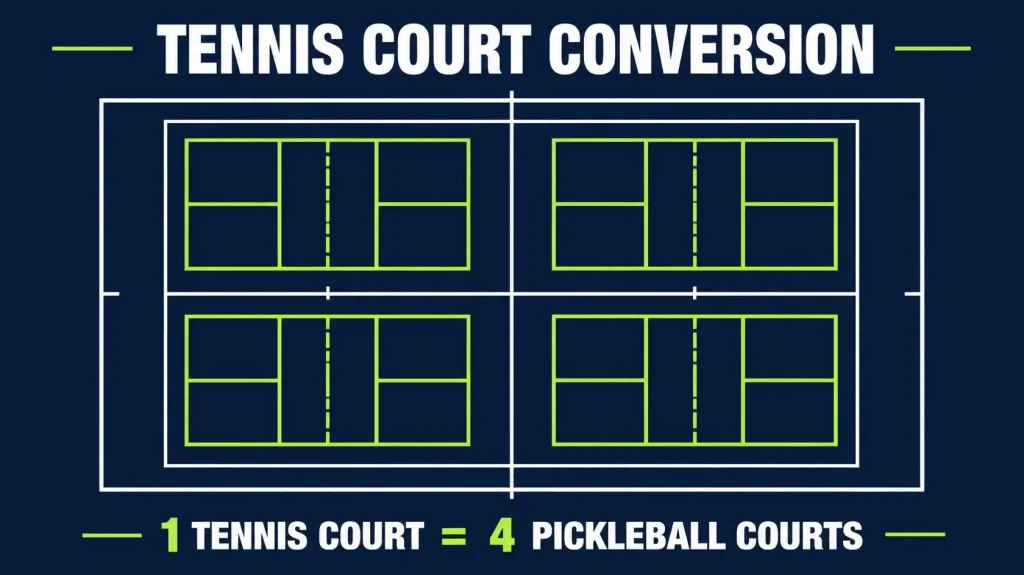
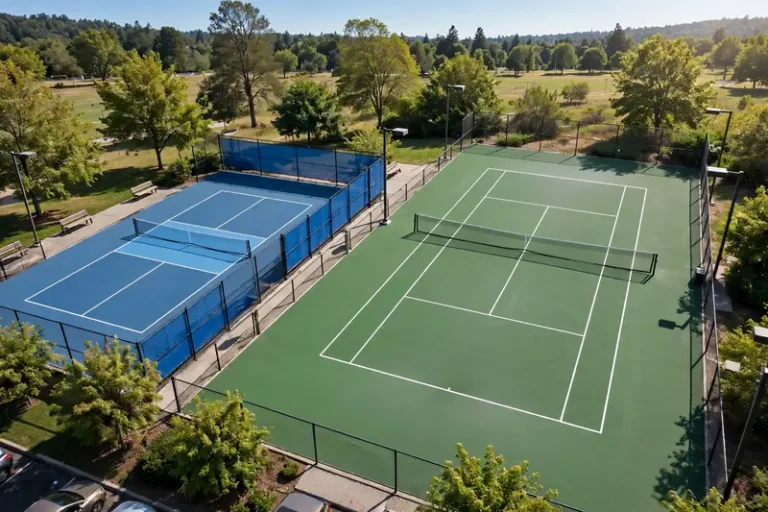
A tennis court is the easiest conversion in sports, because the space and surface are already right. The lines of a tennis court measure 78 feet long and 36 feet wide for doubles. The full slab at most clubs is about 60 by 120 feet, and that footprint holds four pickleball courts turned sideways, two on each side of the old tennis net line.
You have three ways to do it:
- One court, shared use. Keep the tennis court as it is, set a portable pickleball net across one half, and tape a 20 by 44 court. Cheapest option, and where most parks start. Lowering the tennis net is not a real fix: it sits 42 inches at the posts and 36 in the center, which is 6 inches and 2 inches too high for pickleball.
- Blended lines. Paint pickleball lines in a second color on the tennis surface. Both sports keep their court, and nobody loses court time. Line clutter is the tradeoff, so pick a color that stands apart from the tennis lines.
- Full conversion. Restripe the slab as four dedicated pickleball courts with permanent posts. This gives the best playing experience and it is not reversible, so most clubs do it only after demand is proven.
Whichever route you take, the pickleball court dimensions from the table above do not change. Tape or paint the kitchen at 7 feet, the service courts at 10 by 15, and set each net at 36 and 34 inches. A full walkthrough with line layouts for 1, 2, and 4 courts is covered in our guide to pickleball on a tennis court.
Pickleball vs tennis vs badminton court size
| Pickleball | Badminton (doubles) | Tennis (doubles) | |
|---|---|---|---|
| Width | 20 ft | 20 ft | 36 ft |
| Length | 44 ft | 44 ft | 78 ft |
| Playing area | 880 sq ft | 880 sq ft | 2,808 sq ft |
| Net height at center | 34 in | 60 in | 36 in |
The pickleball and badminton courts are identical rectangles with very different nets. The tennis court is more than three times the area, which is why pickleball fits into small parks, gyms, and driveways where tennis never could.
What surfaces can you play on?
Any flat, hard surface works for casual play. For a court you will use every week, these are the realistic options.
| Surface | Where you will see it | Good points | Watch out for |
|---|---|---|---|
| Acrylic coating over concrete | Dedicated outdoor courts | True, consistent bounce; good grip; color choices | Needs a sound slab under it; coating wears over time |
| Acrylic coating over asphalt | Parks, schools, older clubs | Lower cost than concrete | Asphalt moves and cracks sooner, and cracks telegraph through |
| Cushioned acrylic | Clubs, premium home courts | Softer on knees and joints | Costs more per square foot; slightly slower ball |
| Interlocking sport tile | Backyards, driveways | Drains fast, installs over old slabs, forgiving feel | Higher cost per square foot; bounce feels a touch different |
| Hardwood or gym floor | Indoor rec centers | Smooth and fast, already there | Dust makes it slippery; use indoor balls |
Post-tension concrete with an acrylic finish is the build most contractors recommend for a permanent outdoor court. It resists cracking better than plain concrete and gives the most predictable bounce. Clay exists at a handful of clubs, but it is rare and maintenance-heavy, so treat it as a novelty rather than a plan.
How much does it cost to build a pickleball court?
Prices swing a lot by region and by how much ground work your site needs, but these 2026 US ranges will keep a budget honest.
| Setup | Typical cost |
|---|---|
| Chalk or tape lines and a portable net on a surface you own | $100 to $500 |
| Driveway conversion (crack repair, paint or tiles, net) | $350 to $7,500 |
| New asphalt court with acrylic coating and net | $18,000 to $45,000 |
| New concrete court with acrylic coating, net, basic fencing | $25,000 to $50,000 |
| Premium build (post-tension slab, cushion, lights, fencing) | $45,000 to $75,000 and up |
A standard outdoor build lands near $34,000 on average. Site preparation is the number that surprises people: grading and drainage run $2,000 to $10,000 or more, and a sloped or rocky lot can add far more before a line is painted. Lines are the cheapest part of the project at a few hundred dollars, so taping a court on a surface you already own is a smart way to test the habit before you build.
Portable net setup checklist
Before your first game on a temporary court, run through this list.
- Net system spans 22 feet, post to post
- Net is at least 21 feet 9 inches long and 30 inches deep
- Center strap in place and adjusted
- Heights checked with a tape: 36 inches at the sides, 34 at the center
- Lines marked at 20 by 44 feet, kitchen lines 7 feet from the net
- Lines are 2 inches wide, or as close as your tape allows
- Surface swept clear of grit, leaves, and loose stones
- A few feet of clear space behind each baseline, even if it is less than the ideal 8
Most portable systems go up in about ten minutes once you have done it twice. Measure the net height every time anyway. It takes twenty seconds and it settles the argument before it starts.
Frequently asked questions
What are the official pickleball court dimensions?
The official pickleball court dimensions are 20 feet wide by 44 feet long (6.10 m by 13.41 m), set by USA Pickleball in Rule 3.A.1. The same court is used for singles and doubles, indoors and outdoors.
How big is the kitchen in pickleball?
The kitchen, officially the non-volley zone, is 7 feet deep on each side of the net and runs the full 20-foot width of the court. The kitchen line counts as part of the zone. Our pickleball kitchen rules guide explains what you can and cannot do inside it.
What is the net height in pickleball?
The net is 36 inches high at the sidelines and 34 inches high at the center. The center strap holds it at 34 inches, and the small dip is part of the rules, not a defect.
How much space do I need around a pickleball court?
Plan on a total playing surface of at least 30 by 60 feet, which leaves 5 feet beside each sideline and 8 feet behind each baseline. For new courts and tournaments, 34 by 64 feet is the recommended size.
Is a pickleball court the same size as a badminton court?
Yes. A doubles badminton court is also 20 by 44 feet, so the playing rectangles are identical. The nets are very different: badminton plays under a net that is 60 inches high at the center, against 34 inches for pickleball.
Can I play pickleball on a tennis court?
Yes, and it is the most common conversion in the sport. One pickleball court fits on a tennis court with a portable net and taped lines, and a full tennis slab (about 60 by 120 feet) holds four pickleball courts turned sideways.
Can I fit a pickleball court in my driveway?
Usually, yes. A two-car driveway is often 20 to 24 feet wide and long enough for the 44-foot court, though runoff behind the baselines will be short. It plays fine for practice and family games.
What is the best surface for a pickleball court?
For a permanent outdoor court, post-tension concrete with an acrylic sport coating is the most recommended build: it resists cracking and gives a consistent bounce. For a backyard on a budget, interlocking sport tile over an existing slab is the easiest route.
Do singles and doubles use different court sizes in pickleball?
No. Doubles and singles court size is the same: both formats use the same 20 by 44 foot court with the same lines. Singles is harder work, not a smaller court, because one player covers the full width alone.
Checked: October 25, 2026, against the 2026 USA Pickleball Official Rulebook, with 2026 build cost ranges cross-checked across HomeGuide figures and three court builder guides.
8 Comments