How to Play Pickleball: Rules, Scoring, and Your First Game
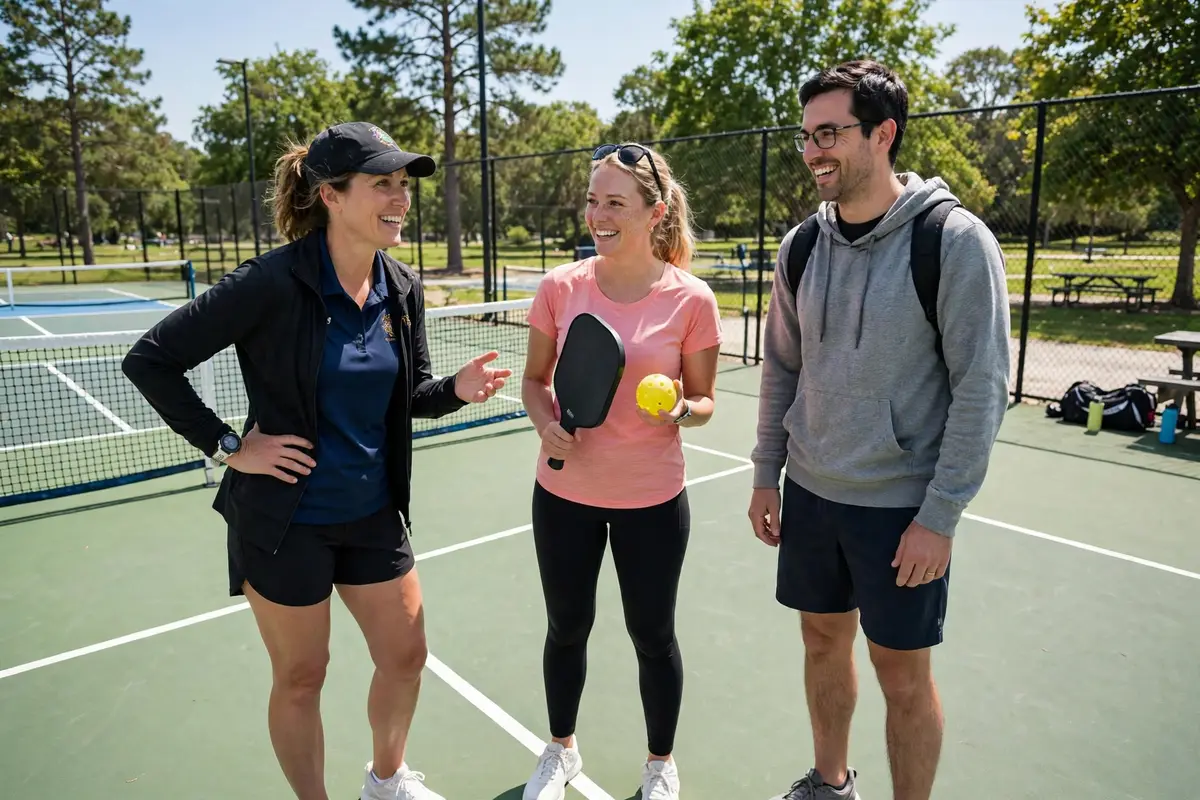
Pickleball is the easiest racket sport to start and one of the hardest to put down. You can learn how to play pickleball in a single afternoon: the court is small, the ball is slow, and the rules fit on one page. This guide shows you how to play pickleball from the very first serve to the final point, with the five rules that matter, a step-by-step first game, and the mistakes to avoid.
Quick answer: How to play pickleball comes down to five rules: serve underhand and diagonally past the kitchen, let the serve and the return bounce once each, never volley while touching the kitchen, only the serving team scores, and games go to 11, win by 2. Bring a paddle, a ball, and court shoes, and you can play your first game today.
What is pickleball?
Pickleball is a paddle sport played on a small court with a low net, a solid paddle, and a perforated plastic ball. It mixes parts of tennis, badminton, and table tennis: the court comes from badminton, the net height from tennis, and the solid paddle from table tennis. Two or four players hit the ball back and forth over the net, and the first side to 11 points, winning by 2, takes the game.
The game was invented in the summer of 1965 on Bainbridge Island, Washington, by Joel Pritchard, Bill Bell, and Barney McCallum. They were looking for something to keep their children busy, so they improvised on a badminton court with ping-pong paddles and a Wiffle ball, then lowered the net from 60 inches to 36 inches. The name came from Joan Pritchard, Joel’s wife, who said the mixed-up game reminded her of a “pickle boat” in rowing, a crew made from leftover rowers. The story about the family dog, Pickles, is the one most people repeat, but the dog arrived after the game was named.
Today pickleball is the fastest-growing sport in the United States, and the reason is simple: a new player can rally within minutes, and a good player can keep improving for years.
What do you need to play pickleball?
You need four things, and none of them has to be expensive.
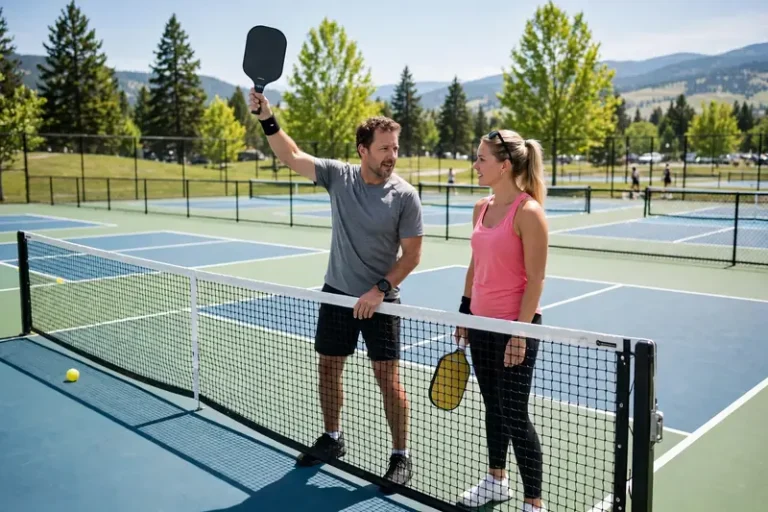
- A paddle. Start with a light, forgiving paddle around 7.5 to 8 ounces. Our guide to beginner paddles lists five picks that forgive mistakes.
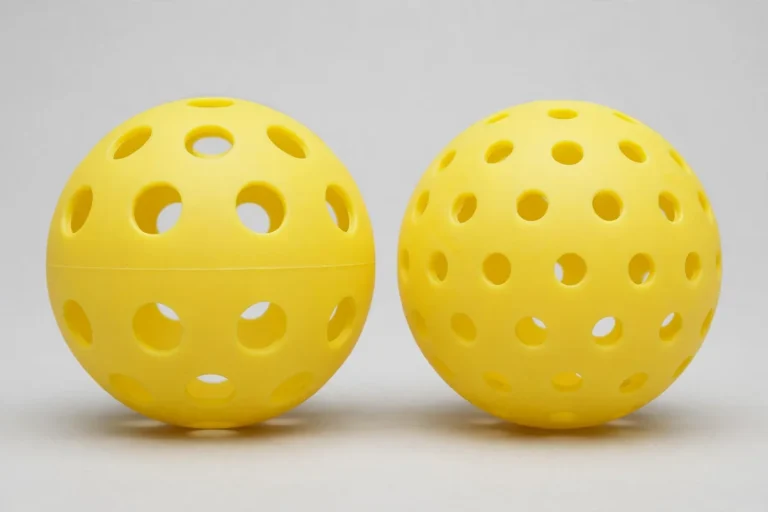
- A ball. Outdoor balls have 40 holes and indoor balls have 26. Use the right one for the surface, or the ball will fly wrong.
- Court shoes. Tennis or pickleball shoes with lateral support. Running shoes are a bad idea: they grip forward and roll sideways, which is how ankles get hurt.
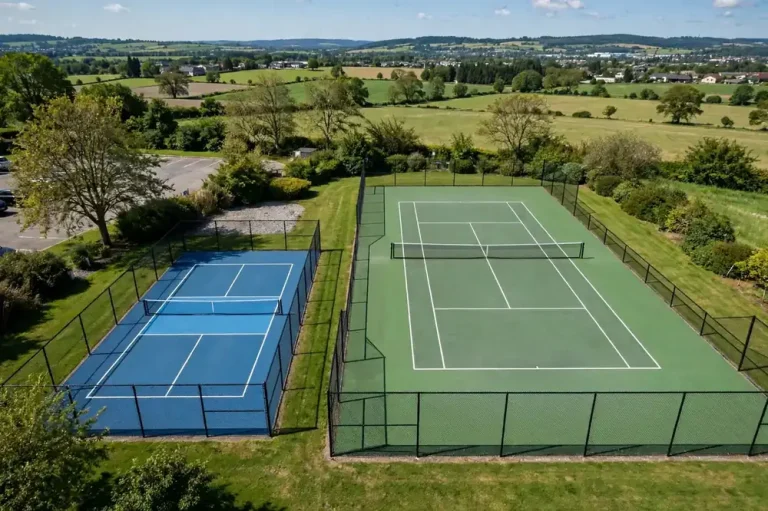
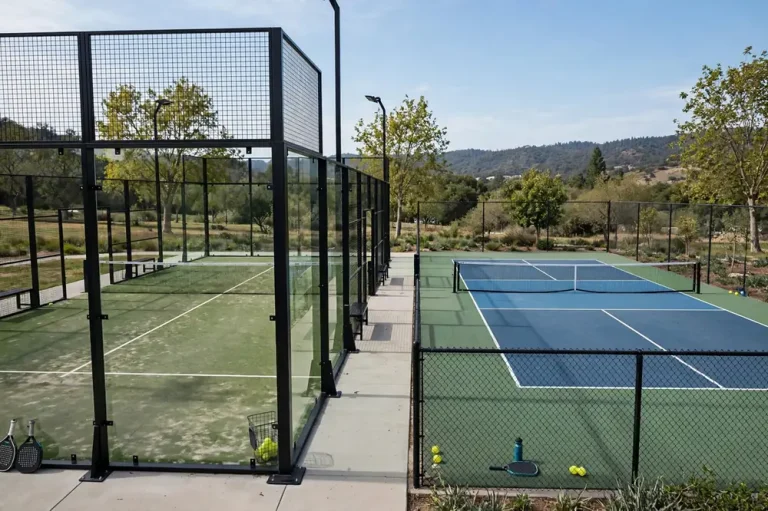
- A court. Most public parks now have dedicated pickleball courts, and many tennis courts have pickleball lines painted on them. Bring water, and you are set.
The court in 30 seconds
A pickleball court is 20 feet wide and 44 feet long, about a quarter of a tennis court. The net is 36 inches high at the posts and 34 inches at the center. The most important line on the court is the kitchen line, 7 feet from the net on each side. The area between that line and the net is the non-volley zone, called the kitchen.
| Part | Measurement |
|---|---|
| Court | 20 feet wide x 44 feet long |
| Net height | 36 inches at the posts, 34 inches at the center |
| Kitchen | 7 feet from the net, both sides |
| Service courts | Split by the centerline, left and right |
Lines are in, with exactly one exception: a serve that lands on the kitchen line is out. Every other ball that touches a line is good. See the full pickleball court dimensions.
The 5 rules you need for your first game
The official rulebook runs to dozens of pages. You need five things. Each one below is a short summary; the link goes to the full guide on that rule.
1. The serve
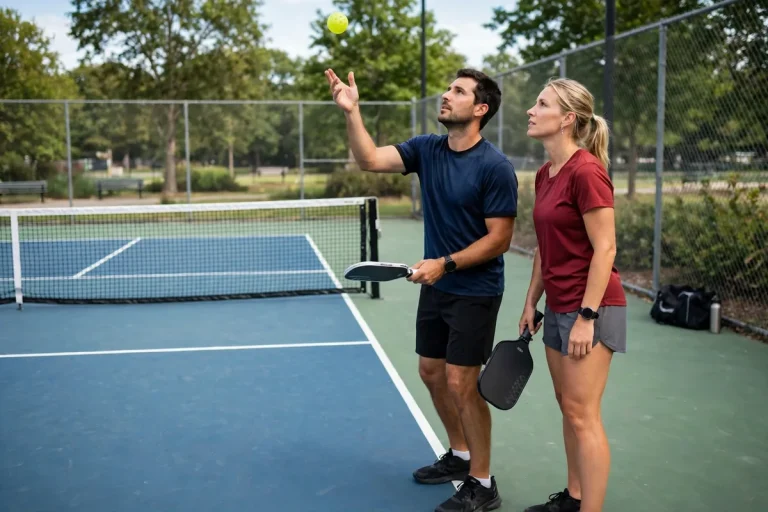
Serve underhand and diagonally, from behind your baseline, into the service court opposite. You get one attempt, there is no second serve, and the serve must clear the kitchen entirely, including its line. If the ball clips the net and still lands in the correct box, it stays in play. There are two legal serves: the volley serve, hit out of the air with contact below your waist and the paddle head below your wrist, and the drop serve, where you release the ball, let it bounce, and hit it with no height or swing restrictions. Most coaches start beginners on the drop serve because it is easier. See the full serve rules.
2. The two-bounce rule
The serve must bounce before the returner hits it, and the return must then bounce before the serving team hits it. Only after those two bounces may anyone volley. This is the rule that makes pickleball pickleball, and it is the one new players forget most. If you volley the return of serve, you lose the rally.
3. The kitchen
You cannot volley while touching the kitchen or its lines, and that includes the moment your momentum carries you in after a volley. You can stand in the kitchen whenever you want, and you can play any ball that has already bounced there. The kitchen is what keeps the game slow and fair: nobody can stand at the net and smash everything. See the full kitchen rules.
4. Scoring
Games go to 11 and you must win by 2. Only the serving team can score: if you win a rally while receiving, you win the serve, not a point. Before every serve, the server calls three numbers: your team’s score, the opponents’ score, and the server number, 1 or 2. So “6-3-2” means we have 6, you have 3, and I am the second server. The first serve of the game is the one exception: it starts at 0-0-2. See how scoring works in the full guide.
5. Lines and faults
A ball that lands on any line is in, except a serve on the kitchen line, which is out. A fault ends the rally and loses the point or the serve. The common faults are hitting out, hitting into the net, volleying in the kitchen, volleying the return of serve, and serving into the kitchen or out of the box. When in doubt, call it honestly: pickleball is a friendly game, and bad calls end friendships faster than bad shots.
Your first game, step by step
Learning how to play pickleball takes one afternoon. Here is the order that works.
- Warm up for five minutes. Hit the ball back and forth over the net with your partner, no score, just to feel the paddle.
- Practice the serve. Take ten serves each, diagonally, underhand, past the kitchen. Use the drop serve if the volley serve feels awkward.
- Play a practice rally. Start with a serve, let it bounce, return it, let it bounce, then play the point out. Do this five times before you keep score.
- Play to 11, win by 2. Call the score before every serve, three numbers, even if it feels silly. It is the only way the habit forms.
- Rotate partners. After the first game, swap partners and play again. Doubles is the best way to learn, because your partner covers the court you cannot.
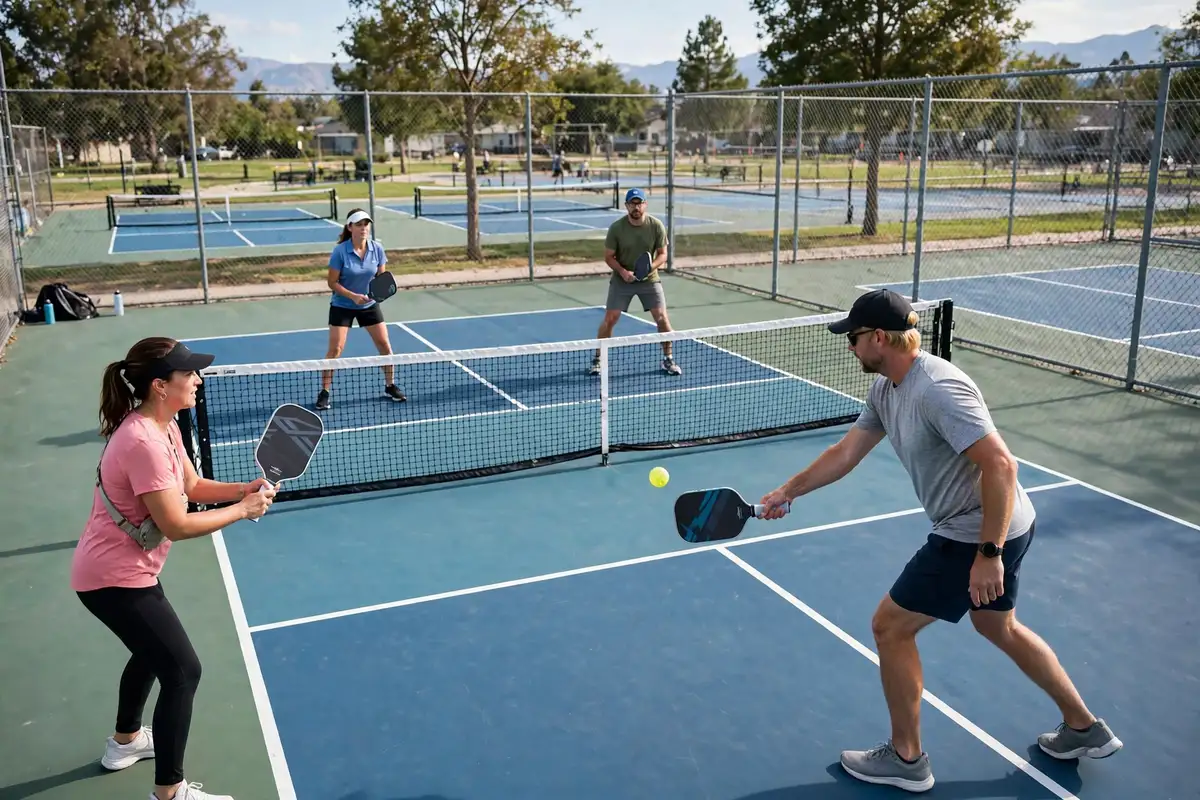
Most beginners play doubles first, and that is the right call. Four players means less running, more rallies, and someone to laugh with when the score gets confusing. Singles is the same game with more running and no partner to cover for you. See the singles rules and the doubles rules for the full details.
Common beginner mistakes
Most people learning how to play pickleball make the same five mistakes. All five are easy to fix.
| Mistake | Fix |
|---|---|
| Standing too far back | Get to the kitchen line after the return and stay there. Most points are won at the net, not the baseline. |
| Hitting every ball hard | Soften your shots. The dink, a soft shot that just clears the net, wins more rallies than a smash. |
| Volleying in the kitchen | Wait for the bounce. If your feet are in the kitchen, let the ball bounce before you hit it. |
| Forgetting the two-bounce rule | Say “bounce, bounce” in your head on the first two shots of every rally until it is automatic. |
| Not calling the score | Call all three numbers before every serve. If you lose track, ask. Nobody minds. |
How to get better after your first game
Once you know how to play pickleball, the next step is simple: play more, and practice the two shots that win most points. The dink keeps you in rallies at the net, and the third shot drop gets you from the baseline to the kitchen without giving your opponents an easy smash. Ten minutes of dink practice before each game will improve your play faster than any new paddle.
After a few weeks, learn stacking, the positioning system good doubles teams use, and study the basic strategy of when to speed up and when to slow down. You do not need a coach to get good, but one hour with a coach will fix habits that take months to unlearn alone.
Common questions, answered
What is pickleball?
Pickleball is a paddle sport played on a 20 by 44 foot court with a low net, a solid paddle, and a perforated plastic ball. It mixes tennis, badminton, and table tennis, and it was invented in 1965 on Bainbridge Island, Washington.
How do you play pickleball?
You serve underhand and diagonally past the kitchen, let the serve and the return bounce once each, then rally until someone faults. Only the serving team scores, and games go to 11, win by 2.
How long does it take to learn how to play pickleball?
Most people rally within their first hour and play a full game the same day. The rules take one afternoon to learn; playing well takes a few months of regular games.
How many players do you need?
Two for singles, four for doubles. Most beginners start with doubles, because four players means less running and longer rallies.
Do I need special shoes?
Yes, court shoes with lateral support. Running shoes grip forward and roll sideways, which is how ankles get hurt on a pickleball court.
What is the kitchen in pickleball?
The kitchen is the 7-foot non-volley zone on each side of the net. You cannot volley while touching it or its lines, but you can stand in it anytime and play any ball that has bounced there.
Where can I play pickleball?
Most public parks now have dedicated pickleball courts, and many tennis courts have pickleball lines painted on them. Check your local parks department or a court-finder app for courts near you.
Related guides
Checked: November 9, 2026, against the USA Pickleball rulebook, the 2026 rulebook notes, and the verified 1965 origin record.